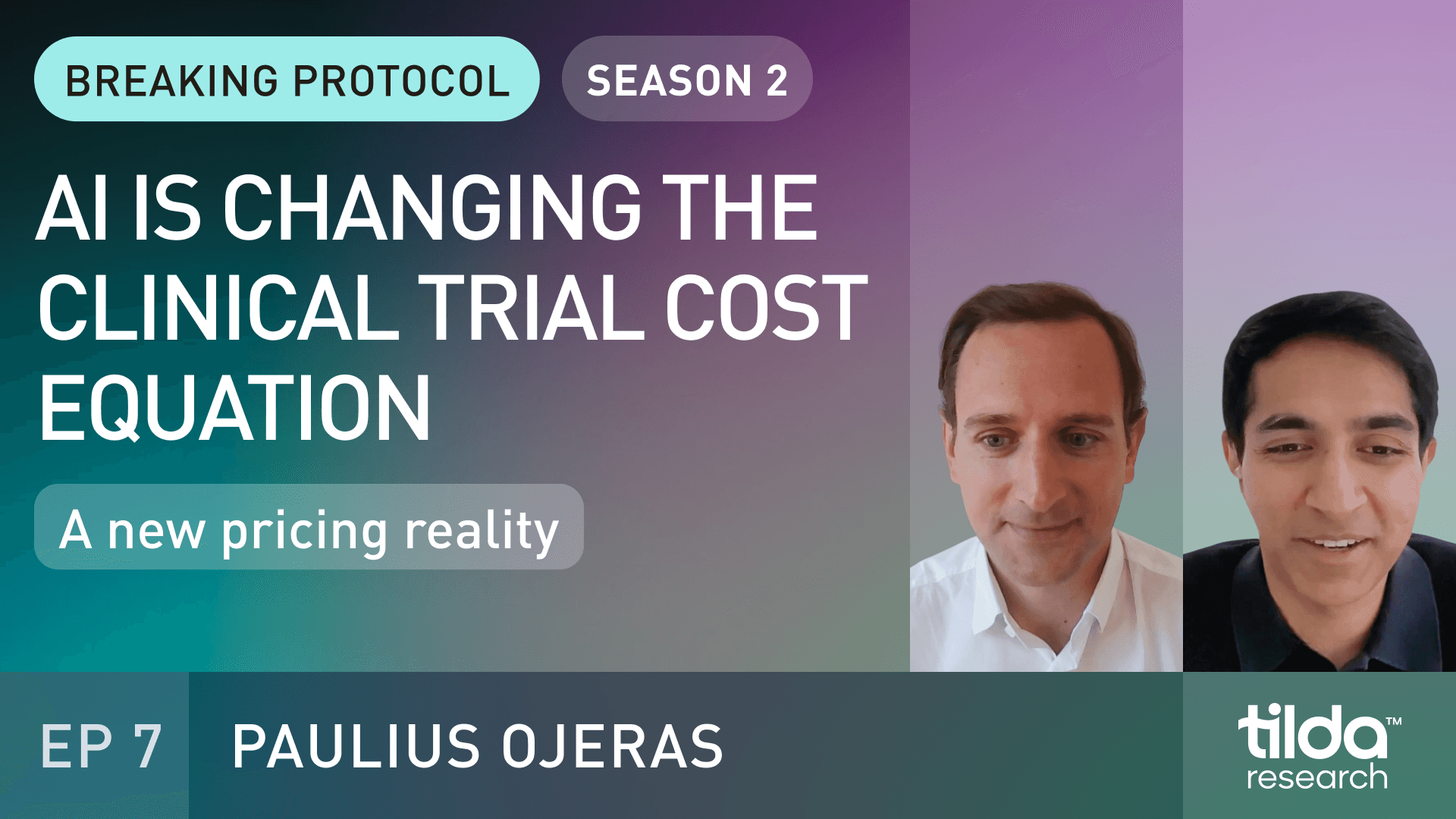
AI is about to force a much bigger conversation in clinical research than most people realize. In this episode, Ram Yalamanchili, CEO of Tilda Research, and Paulius Ojeras, VP of Clinical Operations at Perceive Biotherapeutics, dig into how AI could change the economics of running studies, not just by improving quality and accelerating timelines, but by putting real pressure on the traditional CRO pricing model.
If the work takes fewer hours, gets done faster, and delivers better outputs, what exactly should sponsors still be paying for? That question leads to one of the most fascinating parts of the discussion: whether clinical development is headed toward rebates, new pricing structures, and a very different definition of value.
Transcript
41 min
Ram Yalamanchili (00:04.044)
Welcome, Paulius, to another episode of our podcast. And I'm quite excited to actually have you here. And, you know, I've been following your work and what you've been writing on LinkedIn and a lot of provocative, interesting thoughts on the rise of AI and clinical operations specifically. So I'm quite excited. So for the benefit of our audience, we'd to get a quick introduction from you and some of the work you've been doing right now. And we'll jump into some of the topics I've got.
out of
Paulius Ojeras (00:36.734)
Hello, nice to meet you everyone who is listening. I'm Paulius Ojeras I'm VP Clinical Operations at a small biotech, Perceive Biotherapeutics. Before that, my background comes from the CRO side. I've been 12 years with one CRO where I've exposed with a...
different starting as a CRA went into project management, project oversight, and was establishing vendor management department before jumping to this sponsor side where I was heading clinical operations at a cellular therapy company.
And recently, with all the AI technology development and et cetera, it was an opportunity kind of to try with Tilda and with some other solutions really to explore how we could be more efficient with our day-to-day operations. In the past, I always was very focused on...
How can I optimize my work? I hated to repeat the things for the second time and for the third time even more. So I was always looking for opportunities, how I could automate things and et cetera. And definitely with the AI.
development and agentic AI in particular, this was a fantastic opportunity which I see could really change our industry how we run it. And I'm very excited about all the upcoming opportunities where we could shift our directions and how we could optimize how we run the clinical trials and make them significantly more efficient with a higher quality and
Paulius Ojeras (02:29.234)
way much faster than we were able to do it before.
Ram Yalamanchili (02:34.254)
Oh, so a lot of exciting things we can talk about in various areas you've mentioned, right? And certainly got a few favorites of mine. Oh, yes. So I'll start with the first question, which I've seen you present and talk and publish on, right? The adoption of AI in clinical operations, think is, for lack of a better word, I think I feel it's a niche market. You know, it's not very widely talked about.
a lot of people building for our industry, I would say, you know, in a specialized way, in a dedicated way. And you being at the vantage point of currently running multiple trials and, you know, using and evaluating and buying technology, specifically AI based technology, what can you tell us about what you're seeing? Like, where would you start?
Paulius Ojeras (03:29.916)
I think I would first of all probably mention that there is a huge hype in AI and definitely more and more companies trying to enter clinical operations space as well and clinical development space as a broader because everyone sees as an opportunity. However, after meeting with...
multiple vendors and multiple solution providers, or in the early stage, or claiming to be in a bit more advanced stage. I see a lot of gaps in the available solutions in terms of what they are offering and et cetera. It's everyone wants to ride the hype without really thinking through very thoroughly what the end product would look like. And the basis is driven by the...
great ideas, but execution is still lagging. And I think this is where the biggest concern I have at the moment as an industry, we are kind of try to, everyone to adopt and jump on those solutions, which are not yet really ready for the prime time. And I think this is the biggest challenge where I can see at the moment. At the same time, the opportunities there, I think,
Clinical development in general is extremely complex and extremely complicated activities which are very limited about the capabilities what human can do. So we create an extra loops, an extra multi-layers, oversights and et cetera, because of the complexity and...
That complexity has an opportunity to be resolved with the AI-driven solutions, where we could really design it properly. We could make the things way much more streamlined, way much more efficient, and way much more simplify the complexity for how we run the clinical trials.
Paulius Ojeras (05:44.69)
But that does require a lot of effort, a lot of energy. I don't think that yet there is any solution which is immediately available to resolve it. But the opportunity is definitely there.
Ram Yalamanchili (05:59.95)
sense. And when you're evaluating or when you're looking at, you know, the quarter field, these companies, and by the way, I, I feel like, I hope you agree. The, the hype cycle is important, right? I do think it's an important aspect of developing solutions and, uh, you know, I feel like it's like a feature of capitalism rather than a bug. Like I think you, kind of want this to happen and out of it will come something of value. Maybe not all of it, but some of it. Uh, I'm just curious, like.
Is that kind of how you see it as a net positive on some arc, but maybe you have to do more work now to kind of figure out who it is?
Paulius Ojeras (06:36.926)
I think both ways. do agree that the hype is very important to create and spread the knowledge, spread the...
understanding and the need for the change and et cetera. Right now, I do see that the hype of an abundance of information about AI really spread throughout the industry entirely and everyone is thinking how to adopt the AI solutions and there is a pressure to of adoption as well. My biggest concern is that
that adoption is not really thoughtful. That adoption is just, are buying AI solutions just because half something or to be able to say that we are using something versus buying something which will really create a meaningful value.
and which would really address the efficiency issues, which will address the quality issues which we are currently having, or would create an exponential value from the adoption versus partially automating some step in our existing processes, which by default maybe it's not the best workflow itself.
And by adopting AI, we will be creating sometimes the extra layers of oversight, extra layers of managing it versus really the value that the AI solution will bring us. So do agree that the overall hype is important to spread the awareness and et cetera.
Paulius Ojeras (08:30.05)
But knowing the industry for 20 years, I'm afraid that we may, a lot of us would jump on the hype really without spending too much effort with it. And really the outcome would be contra-efficacy rather than really bringing an added value from what we could really create through the AI properly adopted.
Ram Yalamanchili (08:58.238)
Interesting. So tell us more about what you mean by not buying without thinking through it and of course not getting what you tried to get when you're buying. How are you thinking about it when you evaluate a vendor or what's sort of the process you've adopted to protect yourself in that sense, right? From going through the same cycle.
Paulius Ojeras (09:22.386)
So I think even for me, it was definitely a journey. How I initially considered AI solutions and how I'm thinking right now, it's definitely changed. And it changed very rapidly with the everyday learning and experiencing with it. Initially, indeed, maybe I was more thinking about adoption, very limited.
workflow of automating very limited activities and etc. But right now with the seeing how speedily the technology is developing and seeing those opportunities what could be done if it's properly designed. What I mean the properly designed is that we have an end-to-end workflow thought through how a Genti-KI solution could address for you.
What is the output of it and what value will be creating? How you will be overseeing it and et cetera. When you combined all those elements and et cetera and answer the question, okay, what will be the end result of it? How much investment from the technology perspective? How much investment from the time and energy from my team perspective it will require? And...
Is it really an exponential value increase versus what I'm currently doing? When looking from that lens, you really can very easily filter the solutions which are coming to automate a very tiny step in your process, which will still require somebody to oversee it and et cetera. That end-to-end value probably is very marginal.
versus when you are thinking about the processes and highly repetitive tasks, complex tasks, et cetera, which currently were either not possible to be done with the current infrastructure and just to be fully relying on humans, or it would require like enormous amount infrastructure to be able to execute it and time constraints and et cetera.
Paulius Ojeras (11:44.465)
If you break the entire process and build it to address, to reach the result in maybe in a different way even, with a clear safeguards, clear oversight, governance, could activity maybe of 20, 30, 50 people could be done right now with just observation by one person and with an exponentially shorter period of time.
This is the true value solutions, which I see it's still in an early emerging stage overall in the industry. So I think these kind of the areas which I'm looking right now are the most exciting about that. However, the majority of the market, which I'm seeing currently right now, is coming to help you to address the tiny piece of the process, which at the end of the day,
the marginal value increase is very, very minimal.
Ram Yalamanchili (12:47.374)
That makes sense. So in some ways, when you'd say you have 50 people and you'd like it to be the way where maybe a fraction of that is really doing human in the loop verification of the AI, how would you think about, you know, just like the assessment itself? Because ultimately, if the AI is
doing some part of the work and oversight is really just to make sure it's done the right work. That ratio of like how much value you're or how much efficiency you're getting depends on how good the AI is also, right? Are you seeing any like concerns or have you developed any frameworks in terms of how you evaluate, you assess technology? What sort of like some things you can share there in terms of how you're thinking about from a buying perspective.
Paulius Ojeras (13:41.681)
So from the buying perspective, for me, the first criteria I'm looking at, if the AI technology provider is saying that all the decisions of the especially agentic solutions, it's for you, human in the loop to make the final call and et cetera. For me, it's not really the solution because that creates the bottleneck on the human to.
Ram Yalamanchili (14:06.894)
So you don't want to be the final person to decide. Is that what you're saying?
Paulius Ojeras (14:10.462)
No, I don't think that every single step, this is where the biggest issue is, we are trying to automate existing processes and making it faster, putting human at the very end to verify every single step. That, by default, the process will crash because it will bottleneck on the person who needs to make the decision and etc.
Ram Yalamanchili (14:16.408)
Mm-hmm. Mm.
Ram Yalamanchili (14:30.349)
Mm-hmm. Mm-hmm.
It'll bottle like, right? Yeah.
Paulius Ojeras (14:39.71)
I think I like the solutions and the vendors who started to think differently is that you are building or changing the workflows or changing the automation in such a way that quality by design is already built into the product. That the product guarantees you 99 % accuracy, consistency, and et cetera.
that you could have a possibility to go back to cross-check and et cetera. But those benchmarks is consistently meant from the service provider, from the AI solution, that I am not a person to make a decision on every single decision AI is making or go to trace down every single or the trail to look for the reasoning. I do need to have access to it to be able to sample, check,
in terms of the accuracy and et cetera to make sure that the product is performing as expected. But that benchmarking and et cetera of the accuracy should be already part of the feature of the solution. My oversight is more if it's.
going outside of the predefined steps. And if I identify any kind of the performance issue, then I could go back to the solution provider and say, OK, there is a fundamental quality incident. I look at really what's in it as a bio-incol, let's see, CRO services. CRO has an SOPs.
And those SOPs, have to follow. I have reviewed the SOPs. I agree with them. I accept them, and et cetera. Anything falling outside of those SOPs and that oversight of overall performance is on my side. But if they are not following an SOP, then this is a quality incident, which I am raising to address by the provider. And every point.
Ram Yalamanchili (16:46.51)
That's fascinating. I'll come back to that on that topic of quality and the SLAs on the Seattle side. I think you bring up an interesting point. The way I look at it is when you buy a product, there is an SLA. Any software you buy generally has an SLA. I think your expectation of an AI-based product is it is providing you an SLA on the quality of its output. And you also want to be more of an exception-driven
Oversight rather than you are the main driver of oversight or human the little prey that there's a difference in terms of how you see yourself working with the AI here Sort of like if you you were to pay a CRO to do a certain job, they're doing the job You're over sighting them. You're not actually doing their job in terms of like signing off in every single decision like that's kind of like the the nuance here, right in terms of what the
Paulius Ojeras (17:42.367)
I would say that I would differentiate, at least for myself, I'm differentiating it in such a way. Human in the loop for every step and human oversight, there is two different areas. Human in the loop of every step, that should be addressed through the design of the solution.
that you should still have a possibility to cross-check the decisions, do you have a full audit trail and et cetera. But if the solution is built only by a human in the loop to make the final decisions and et cetera, as we discussed, that solution is set up to crash.
because it will produce so much outputs that you will create another department to do the just human in the loop and to make those final decisions and calls. So it just doesn't make any sense. So when you address through the design of the product,
Ram Yalamanchili (18:45.422)
Yeah.
Paulius Ojeras (18:50.046)
through the quality, through the features, through the ability to QC check and et cetera, showing the benchmarks if it is constantly meeting and et cetera. Human in the loop element, it could be random sampling really to make sure that the AI is performing as expected versus human oversight.
is you're looking at from the different scale. You're looking at how overall it fits with your other workflows, how overall it's performing. you want to change something and et cetera, adjust those benchmarks we have set up at the very beginning. This is more like a different approach of the performance overview.
So this is kind of, think I would differentiate those elements in terms of checking or expecting to check every single step of AI versus really doing the full higher level oversight. And that's it.
Ram Yalamanchili (19:54.382)
Yeah, no, it makes a lot of sense, right? It's like a lot of people, I mean, we spoke about it, like, you know, using a tool like, I think I just recently saw a post from you on LinkedIn. And it was essentially my point was, yes, you can use cloud or, you know, open AI's, charge GVT for many things you would normally do on a day to day basis. But the premise of almost all those tools is that you are the final arbiter.
You are the person who's doing the human in the loop. Every decision ultimately falls back onto you as the person who's like prompting it and receiving the information back and then assessing what's the next step. So you're essentially the bottleneck why a charge GPT or a cloud cannot basically just go out there and like do all the, you know, the complex workflow which we should expect it to do. Now that is where agentic AI is coming in, where you have better understanding, task planning, turnaround, things like that.
to your point, understanding how those systems behave really, really well in a complex workflow environment like clinical research and being able to stand behind it because you've done the hard work of understanding the evaluation criteria of these like AI agents and AI, in our case, we call them AI teammates and spending a rigorous amount of time just really like testing and understanding the boundaries.
And at what point you would absolutely need a human and at what point you don't need a human, right? I think that's kind of like what we're saying is a trust building, evaluation criteria, the quality metrics and the quality by design as you call it, where that all needs to come in, in these systems.
Paulius Ojeras (21:34.942)
Exactly, and they are evolving as well. it's maybe you start, you start a very rigorous and very, very detailed oversight and et cetera. And when you see the continuous improvement of performance and et cetera, you could lose in it and et cetera. It's...
Ram Yalamanchili (21:54.882)
Yeah, I mean, we have this in RBQM, isn't it? Like, isn't this kind of the risk-based approach in other areas? Yeah.
Paulius Ojeras (21:59.839)
Yeah, I think it's everywhere. It's everywhere. I think it's even when you're onboarding the new person, it's exactly the same approach. You give maybe more thoroughly overseeing at the very beginning, then you're loosening it. If they start not performing, then you're returning back and making the adjustments. So the concept is...
Ram Yalamanchili (22:07.778)
That's right, yeah, that makes sense.
Ram Yalamanchili (22:22.246)
I joke that some of the titles of our AI engineering staff should be really HR for AI teammates, because that's what it feels like. You're questioning the persona of the AI and just making sure everything's OK. It's having a good day on every day basis. So I get it. It makes sense. Actually, that point, going into that topic,
You run a clinical operations team right now, and I'm curious, how do you think, or do you think organizations will start to change in terms of the type of roles, the type of titles which will exist? And are you seeing anything right now which is already happening, or do you expect things to happen in the near term, mid term? I'd be curious to hear your thoughts on how things will evolve as...
more and more of these AI tools start to get adopted or do you have your AI teammates or agents starting to help with the work as well,
Paulius Ojeras (23:22.098)
Definitely, definitely there will be a lot of changes. And I think in general clinical operations throughout the years, it significantly grew in quantity, but not in quality. We have created a multiple layers of very specialized tasks and et cetera. And I think the quality really decreased.
I do see with the agenti-KI solutions an opportunity to significantly boost back the quality in terms of how we run the trials. And that would require some shift in terms of our structures and et cetera, how we run the clinical trials. At the same time, I'm not afraid in terms of, I think one of the colleagues when we started to adopt agenti-KI was saying, oh, well, so.
Right now, we'll lose our job because agents could really actually do that. And my response to that was actually on opposite. It gives you an opportunity to grow because what you were able to do it before and what you will be able to do with a Gentikia solution, it just exponentially increases. It gives you an opportunity to...
not to do that task yourself, but delegated to agentic AI to do those tasks. And you are becoming an oversight person for that. So that is one opportunity. And the other opportunity is that being all the repetitive, monotonous tasks and et cetera could be very easily handled by AI. Now you give and freeze up your space to do something more meaningful and more important to make the decisions to.
to think about how to make things better, and et cetera. So I think this is great opportunity to evolve and develop and be more creative and et cetera. But in the past, we were spending all of the time in just doing those repetitive tasks, which... So I think that's important.
Ram Yalamanchili (25:38.35)
That makes sense. do you think the organizational, like, so does that mean the job descriptions and even the traditional titles which we have in our industry in the Clonops space, like is that evolving or do you see that evolving as well as you sort of train yourselves to be, I don't know, the person who's able to delegate, right? Delegate to the AI in this case.
Paulius Ojeras (26:02.482)
Definitely, yes. that's why we made a decision within the company to acknowledge that being early adopters and some of our team's titles have been changed really to call them what they actually started to do is being agent AI coordinators. Yes. Correct.
Ram Yalamanchili (26:23.662)
Really? That's the title? Agentic AI Coordinator? Wow. Okay. I am not sure, but you probably are the the the torchbearer on that particular title. You probably own it right now. And hopefully more people will follow through. But it makes a lot of sense. You're essentially coordinating AI or your agentic AI coordinator. Yeah. Okay. That's awesome. I have a slightly sort of like related question here.
I know you mentioned you're a small biotech, but you are taking a lot of the work which is normally perhaps outsourced or given to a CRO and you're doing it in-house. You have a very unique and innovative model where you have coordinators who are actually agentic AI coordinators now. And you're really like able to do a lot more than probably what you could have done.
in the past year. And I think this ratio will probably continue to increase as more more tools and other companies and other solutions start to come onto the field. What my curiosity is, how does the decision making work? I don't hear many small biotech really trying to do trials in-house. But I am curious, do you think you have any advice on how others should think?
Is this a decision which was made for any specific reason? I'm just curious what your thoughts are on that.
Paulius Ojeras (27:55.079)
So I think it was definitely, we made a very bold decision to bring things in house. It's still not easy and et cetera, but we wanted to be close to the clinical sites and for our pivotal program. And that was the main criteria for that. And definitely I do see an opportunity right now with a...
either specific task or more with the time, it will be more and more complex activities and et cetera, where you have an opportunity to think about, okay, typically I was going through the CRO, I have that right now an opportunity to do it myself with the Agenda KI solutions, especially for the task which in the past was not feasible because of the...
time constraints, the scalability, or just knowledge as well. Let's take an example of site feasibility. Right now, the knowledge you could get through the AI solutions, the knowledge, the scalability you were not able to handle because of the human resources, and the productivity to get things turned around very quickly.
You could, to some extent, get really using AI solutions, address it, and get that thing done by yourself without engaging the external party. If you have some extended knowledge in therapeutic area, maybe you already have.
predefined or you have been running recently a couple of other clinical trials and you know this kind of space pretty well, you could really define those rules and parameters and etc. and run the feasibility effectively by yourself, which was maybe not really feasible because of different constraints you had in the past. So I think those areas are evolving for sure.
Paulius Ojeras (30:13.744)
At the same time, think it's also on the CRO side, it also gives an opportunity to be more effective and more efficient and apply that all the historical knowledge we have and the specific therapeutic area and et cetera, and be able to give you the better outputs and et cetera. it's a...
It gives an opportunity, but at the same time, think it gives the pressure for the zeros to bring even more value than they were bringing to date because there is just a simple traditional feasibility. Now, if I could do it myself.
what is an added value SSC role you are bringing. So I think it's a win-win situation for the industry overall because it creates an extra pressure to have a better quality product.
Ram Yalamanchili (31:13.006)
I see. I see. So that's interesting, right? I think you picked Feasibility and I'm curious if you were giving advice to other biotechs who are probably thinking about this similar line. Are there areas which are, think, how would you even approach it? Like if my default view is that I'm a small biotech, I generally just want to outsource or I'm comfortable outsourcing to a CRO.
Is there sort of like a calculus on saying, you know, you can do this yourself, but do that with somebody else or, or what is sort of like the right way of, I guess, thinking about it, if you were to decide that you want to use some of these AI tools and sort of like bring some of this work in-house, right? Where would you start and how do you go about it outside of visibility?
Paulius Ojeras (32:01.119)
I think it really would depend on what stage of the program you are in and also what is your model in general, how comfortable you are bringing things in-house and etc. I think it would vary from person to person as well. If you are used to work only through the CROs,
Probably I would advise them to find a CRO who has adopted those AI solutions and et cetera, and will bring your higher value and et cetera. If you have been in the past and are capable of and interested in bringing things in house to be able to control things more by yourself, especially in the early stage of development and et cetera.
I think right now there is more and more opportunities to do that with the AI by yourself without relying fully on the serial. And I think as an example, which we are working together on TMF management, this was one of the areas which was almost impossible in the past to bring it in-house for the small biotech.
because the technology was not there, you have to have massive infrastructure to maintain it and et cetera. Now with the Agentec AI solution, you could really bring it in-house and be able to manage it by yourself without creating the entire department to do it. It could be done by the individual person.
Ram Yalamanchili (33:40.846)
Yeah, Interesting. And as you're thinking through this, right, what do you think is the impact then? You know, like, I'm just thinking out loud here over the next 12 to 18 to 24 months, as more of the technology starts to proliferate, as it starts to mature, you know, I do think what you're seeing is not unusual.
There are companies who are starting to adopt these AI technologies and starting to see a pretty sea shift in terms of productivity gain and how they can perform some of these workflows. If CROs are doing it, that's great. They're capturing that productivity for themselves. from a, again, a buyer person, I know we've talked about AI technology as what you're buying, but let's just say you're buying services, buying CRO services, right, as a buyer.
What's the thesis there? Like, do you think there'll be a new way of like pricing, new way of negotiating for what you're buying? Like where do you think Klonop's leaders should be thinking about when they're saying one choice is I do it with some parts of help from an external entity or you've got the traditional route where I'm just going to outsource it. But if you chose the latter part, which is the, like I would say the more popular path at this point, how would that discussion change, you think?
Paulius Ojeras (35:02.78)
I think right now, definitely, I'm not sure how quickly it will change, but with AI technology changing everything every single day. So I hope that it will be a very fast shift in the industry because as we mentioned, we are buying services from the CEOs. And now with the...
AI technologies is that those productivity and scalability and efficiency and even quality metrics changes entirely. So that will have to be somehow reflected in the pricing as well, because they are evolving and they are changing and what you were.
Typically in the past, the budgets from the CRO site were based on the number of hours spent by the individual persons and et cetera. Right now, some of those activities could be completely eliminated and done by the agent-tki solution.
So how that pricing would actually will be shifting because we no longer require 100 hours to do the task. Maybe in the right now it requires only 10 hours of oversight and that's it. So the whole model will be definitely shifting. And I think what is unique and coming back to the previous discussion is that
Ram Yalamanchili (36:32.686)
Mm-hmm.
Paulius Ojeras (36:39.664)
Accessibility to biotechs and pharma and et cetera to those tools directly, it creates the pressure for the CROs to adjust those pricing. Maybe in the short term, they will get the benefit of that adoption or implementation cost and et cetera throughout the next months and et cetera. But down the road, I see definitely that will have to be passed on to the buyers.
to be able to see that benefit of the AI adoption.
Ram Yalamanchili (37:15.79)
I see. So that is fair. I think what you're also saying is that there's more transparency around what it costs to do this. And it's also accessibility because you can also do it because you don't need an army of people for some of these, right? So obviously the bar is lower to kind of say build or buy versus, I mean, guess like in-house versus outsource, that's the decision we're making. And some of the...
some of the usual challenges go away when you start comparing AI-based services versus traditional services. But in that regard, I'm just curious, do you think then the structure will morph into something like, well, I'm doing a phase two or a phase one, it's a two to three-year contract, maybe three to five-year contract, depending on how the studies are structured?
But you know that in a timeframe of starting from today, which is 2026, five years out, I would imagine a world where AI is proliferated much more than where is today. Some of the challenges which you have brought up, is, you know, we are certainly in a hype cycle. There's a lot of noise in the market. Not all products have reached maturity. Some of them have, and some of them are improving the...
the envelope of what they can do, right? So you're starting with a handful of areas and then you're expanding into other areas. But I do think like in a multi-year context, AI will proliferate, you kind of have to. And do you think there's going to be like downward pressure then, like across the board in terms of like how much it would have to cost to do what we're doing today for a typical, is it, we like entering into an era where like there's going to be deflationary like sort of situation?
which I guess arguably is good for biotech, probably not so great from a Seattle perspective, but maybe there's some offsets there which we can talk about. But is this sort of like a view which you share or is there like a different sort of opinion out there?
Paulius Ojeras (39:15.358)
I definitely think that it will get there for sure. I right now it could be a good way to evaluate how the CRO or the service provider is looking about the technologies and how advanced they are with that. If they really have the pipeline in terms of how they will be improving things and et cetera. If they are not willing and hoping to...
negotiate it and put a clause like in the future kind of rebate for the AI efficiencies and etc. I think they either very early in the development of adoption of AI or they just wanted to cash it out right now.
Ram Yalamanchili (40:05.006)
fascinating topic. So what you're essentially pointing out is
It's almost like assessing the vendor by asking them what percentage rebate can you give me over the course of next three years. And that rebate could probably start small and increase over time because that's what's going to happen. We all know that AI is going to proliferate in everything we're doing. And I guess the confidence can be seen very easily based on what that number looks like.
Paulius Ojeras (40:36.21)
Yeah. I think it's, of course, it's more complex than that. think there are certain tasks which are kind of heavily performed at the very beginning of the study. There are some activities, of course, throughout the end of the study. And still there is a lot of unknown how much of efficiency different tasks and different activities of AI will give us.
But I think having an opportunity definitely to revisit it down the road, it should be probably the default because right now the default is inflation rate. It's not the up.
Ram Yalamanchili (41:17.358)
That's right. That's right. And it's a very interesting topic because this is happening in other service industries, right? Like I have seen some interesting conversations around legal, for example, and legal AI and legal AI tech has, I would say, matured quite a bit. In the last two to three years, there's been the likes of Harvey and Legora and so these companies which have really like matured in terms of being able to build products which are
functional, which are clearly able to deliver value to their customers and, you know, and at a large enough scale, right, large enough surface area. And one of the things which I think is happening pretty rapidly right now with consumers of legal services. So if you're a Fortune 500 company going out to a top 20 law firm, and you're saying you're going to be my preferred vendor for the next five years, but their billable rates are astronomical.
astronomical to begin with, right? I mean, you're talking about a partner making $2,000, $3,000 an hour. And I think that's all fair. The billing rate itself will probably be what it is. But I think it's also something which I'm hearing where these large consumers of these services will say, that's all great. Your hour is worth $2,000. I'm not going to argue with that. Or maybe $5,000, whatever the large number is. You are absolutely worth it because you have that knowledge and expertise and whatnot.
I do expect your billable numbers to come down. And the way you do that is by using one of these, one of many technologies out there, which are agentic and AI solutions. so whatever that number is, right, that's the comparative that you would have to present to me. You know, law firm A is telling me they're going to give me, you know, X percentage off in year one and, you know, X plus Y percentage in year two and so on and so forth. That's an increasing number as time progresses.
So let's look at both of your curves, right? What is it you're able to present on somebody else? And I think that's kind of like a sign of like, you know, I'm not questioning your billable rate. I'm not questioning anything else outside the thing which runs your business. I'm only questioning what's your efficiency rate, which you'll bring in through AI. And I want a small part of that back to me because I think it's good for everybody, you and us, right? So if that is the model where clinical operations is going,
Ram Yalamanchili (43:44.972)
I think on a net basis, it's probably great for everybody involved because it's not just the cost, right? think quality will also improve as a byproduct of something like this happening. And I'm hoping that's something which, you know, maybe there's a different cause there, but I have, you know, in the past, you know, obviously bought technologies and various types of solutions, but uniquely in a services industry like CROs, one of the things which I'm always curious is,
Is there a way to introduce some kind of an SLA? I think you were earlier in our conversation talking about a quality based SLA for AI, right? But do you think like that's coming? Like, do you feel like if things are moving this route, maybe the industry will demand a certain SLA, which is quite measurable. Previously hard to measure, but maybe like easier to measure now with AI, right?
Paulius Ojeras (44:36.446)
I think it's still early to measure right now, but I think definitely that's the direction we should be going. At the same time, I would hope that the adoption is coming and coming to all those organizations very responsible and et cetera. Returning back to the start of our conversation that it's not we are just...
adopting AI because there is a pressure to adopt that we are really thoughtful about how and where we implement it, which really creates the big value, et cetera. So this is, think, then the cost itself will play out at the very end. I think to some extent, if I would be able to get exponentially better quality,
or for the same price for the exponentially increased or suppressed timelines, maybe I'm willing to pay the exactly same amount of money. What I'm paying is the significant improvement of the quality and significant cutting of the timelines and et cetera. Maybe this is, yeah.
Ram Yalamanchili (45:54.606)
That's interesting. So there's another dimension we're talking about where it's not just a rebate on cost, but maybe there's an accelerator based on quality. So these two kind of play off against each other. There's like a multiplier, right? Like you actually get a bonus versus the rebate. But maybe there's...
Paulius Ojeras (46:11.966)
Yeah, because if it is just about rebate and et cetera, I think it's not worth it at all. Because if it will create an extra efforts and energy to really do that trial and et cetera, maybe it's pointless. think overall what I'm seeing and thinking always about agentic AI solutions, it's...
that you could really exponentially increase the quality, cut on the timelines, and reduce the price. This, in the past, you have to choose two out of three. Right now, I think this is where the
Ram Yalamanchili (46:57.518)
out of three right?
Paulius Ojeras (47:03.238)
an opportunity is to get all of three at the same time. If you're properly and thoughtfully implement them and the solution is really built with quality, efficiency, and in mind from the very beginning, from the day one.
Ram Yalamanchili (47:22.926)
makes sense. Well, that's a really enjoyable conversation, Paulius. I feel like I've learned a lot. just enjoyed, you've clearly spent a bunch of time thinking this through and buying and evaluating solutions and things like that. thanks for taking the time being here. I hope you enjoyed the conversation as well. And I'll talk to you soon. Yeah. Thank you.
Paulius Ojeras (47:47.528)
Always. Thank you. Thank you.
Ram Yalamanchili (00:04.044)
Welcome, Paulius, to another episode of our podcast. And I'm quite excited to actually have you here. And, you know, I've been following your work and what you've been writing on LinkedIn and a lot of provocative, interesting thoughts on the rise of AI and clinical operations specifically. So I'm quite excited. So for the benefit of our audience, we'd to get a quick introduction from you and some of the work you've been doing right now. And we'll jump into some of the topics I've got.
out of
Paulius Ojeras (00:36.734)
Hello, nice to meet you everyone who is listening. I'm Paulius Ojeras I'm VP Clinical Operations at a small biotech, Perceive Biotherapeutics. Before that, my background comes from the CRO side. I've been 12 years with one CRO where I've exposed with a...
different starting as a CRA went into project management, project oversight, and was establishing vendor management department before jumping to this sponsor side where I was heading clinical operations at a cellular therapy company.
And recently, with all the AI technology development and et cetera, it was an opportunity kind of to try with Tilda and with some other solutions really to explore how we could be more efficient with our day-to-day operations. In the past, I always was very focused on...
How can I optimize my work? I hated to repeat the things for the second time and for the third time even more. So I was always looking for opportunities, how I could automate things and et cetera. And definitely with the AI.
development and agentic AI in particular, this was a fantastic opportunity which I see could really change our industry how we run it. And I'm very excited about all the upcoming opportunities where we could shift our directions and how we could optimize how we run the clinical trials and make them significantly more efficient with a higher quality and
Paulius Ojeras (02:29.234)
way much faster than we were able to do it before.
Ram Yalamanchili (02:34.254)
Oh, so a lot of exciting things we can talk about in various areas you've mentioned, right? And certainly got a few favorites of mine. Oh, yes. So I'll start with the first question, which I've seen you present and talk and publish on, right? The adoption of AI in clinical operations, think is, for lack of a better word, I think I feel it's a niche market. You know, it's not very widely talked about.
a lot of people building for our industry, I would say, you know, in a specialized way, in a dedicated way. And you being at the vantage point of currently running multiple trials and, you know, using and evaluating and buying technology, specifically AI based technology, what can you tell us about what you're seeing? Like, where would you start?
Paulius Ojeras (03:29.916)
I think I would first of all probably mention that there is a huge hype in AI and definitely more and more companies trying to enter clinical operations space as well and clinical development space as a broader because everyone sees as an opportunity. However, after meeting with...
multiple vendors and multiple solution providers, or in the early stage, or claiming to be in a bit more advanced stage. I see a lot of gaps in the available solutions in terms of what they are offering and et cetera. It's everyone wants to ride the hype without really thinking through very thoroughly what the end product would look like. And the basis is driven by the...
great ideas, but execution is still lagging. And I think this is where the biggest concern I have at the moment as an industry, we are kind of try to, everyone to adopt and jump on those solutions, which are not yet really ready for the prime time. And I think this is the biggest challenge where I can see at the moment. At the same time, the opportunities there, I think,
Clinical development in general is extremely complex and extremely complicated activities which are very limited about the capabilities what human can do. So we create an extra loops, an extra multi-layers, oversights and et cetera, because of the complexity and...
That complexity has an opportunity to be resolved with the AI-driven solutions, where we could really design it properly. We could make the things way much more streamlined, way much more efficient, and way much more simplify the complexity for how we run the clinical trials.
Paulius Ojeras (05:44.69)
But that does require a lot of effort, a lot of energy. I don't think that yet there is any solution which is immediately available to resolve it. But the opportunity is definitely there.
Ram Yalamanchili (05:59.95)
sense. And when you're evaluating or when you're looking at, you know, the quarter field, these companies, and by the way, I, I feel like, I hope you agree. The, the hype cycle is important, right? I do think it's an important aspect of developing solutions and, uh, you know, I feel like it's like a feature of capitalism rather than a bug. Like I think you, kind of want this to happen and out of it will come something of value. Maybe not all of it, but some of it. Uh, I'm just curious, like.
Is that kind of how you see it as a net positive on some arc, but maybe you have to do more work now to kind of figure out who it is?
Paulius Ojeras (06:36.926)
I think both ways. do agree that the hype is very important to create and spread the knowledge, spread the...
understanding and the need for the change and et cetera. Right now, I do see that the hype of an abundance of information about AI really spread throughout the industry entirely and everyone is thinking how to adopt the AI solutions and there is a pressure to of adoption as well. My biggest concern is that
that adoption is not really thoughtful. That adoption is just, are buying AI solutions just because half something or to be able to say that we are using something versus buying something which will really create a meaningful value.
and which would really address the efficiency issues, which will address the quality issues which we are currently having, or would create an exponential value from the adoption versus partially automating some step in our existing processes, which by default maybe it's not the best workflow itself.
And by adopting AI, we will be creating sometimes the extra layers of oversight, extra layers of managing it versus really the value that the AI solution will bring us. So do agree that the overall hype is important to spread the awareness and et cetera.
Paulius Ojeras (08:30.05)
But knowing the industry for 20 years, I'm afraid that we may, a lot of us would jump on the hype really without spending too much effort with it. And really the outcome would be contra-efficacy rather than really bringing an added value from what we could really create through the AI properly adopted.
Ram Yalamanchili (08:58.238)
Interesting. So tell us more about what you mean by not buying without thinking through it and of course not getting what you tried to get when you're buying. How are you thinking about it when you evaluate a vendor or what's sort of the process you've adopted to protect yourself in that sense, right? From going through the same cycle.
Paulius Ojeras (09:22.386)
So I think even for me, it was definitely a journey. How I initially considered AI solutions and how I'm thinking right now, it's definitely changed. And it changed very rapidly with the everyday learning and experiencing with it. Initially, indeed, maybe I was more thinking about adoption, very limited.
workflow of automating very limited activities and etc. But right now with the seeing how speedily the technology is developing and seeing those opportunities what could be done if it's properly designed. What I mean the properly designed is that we have an end-to-end workflow thought through how a Genti-KI solution could address for you.
What is the output of it and what value will be creating? How you will be overseeing it and et cetera. When you combined all those elements and et cetera and answer the question, okay, what will be the end result of it? How much investment from the technology perspective? How much investment from the time and energy from my team perspective it will require? And...
Is it really an exponential value increase versus what I'm currently doing? When looking from that lens, you really can very easily filter the solutions which are coming to automate a very tiny step in your process, which will still require somebody to oversee it and et cetera. That end-to-end value probably is very marginal.
versus when you are thinking about the processes and highly repetitive tasks, complex tasks, et cetera, which currently were either not possible to be done with the current infrastructure and just to be fully relying on humans, or it would require like enormous amount infrastructure to be able to execute it and time constraints and et cetera.
Paulius Ojeras (11:44.465)
If you break the entire process and build it to address, to reach the result in maybe in a different way even, with a clear safeguards, clear oversight, governance, could activity maybe of 20, 30, 50 people could be done right now with just observation by one person and with an exponentially shorter period of time.
This is the true value solutions, which I see it's still in an early emerging stage overall in the industry. So I think these kind of the areas which I'm looking right now are the most exciting about that. However, the majority of the market, which I'm seeing currently right now, is coming to help you to address the tiny piece of the process, which at the end of the day,
the marginal value increase is very, very minimal.
Ram Yalamanchili (12:47.374)
That makes sense. So in some ways, when you'd say you have 50 people and you'd like it to be the way where maybe a fraction of that is really doing human in the loop verification of the AI, how would you think about, you know, just like the assessment itself? Because ultimately, if the AI is
doing some part of the work and oversight is really just to make sure it's done the right work. That ratio of like how much value you're or how much efficiency you're getting depends on how good the AI is also, right? Are you seeing any like concerns or have you developed any frameworks in terms of how you evaluate, you assess technology? What sort of like some things you can share there in terms of how you're thinking about from a buying perspective.
Paulius Ojeras (13:41.681)
So from the buying perspective, for me, the first criteria I'm looking at, if the AI technology provider is saying that all the decisions of the especially agentic solutions, it's for you, human in the loop to make the final call and et cetera. For me, it's not really the solution because that creates the bottleneck on the human to.
Ram Yalamanchili (14:06.894)
So you don't want to be the final person to decide. Is that what you're saying?
Paulius Ojeras (14:10.462)
No, I don't think that every single step, this is where the biggest issue is, we are trying to automate existing processes and making it faster, putting human at the very end to verify every single step. That, by default, the process will crash because it will bottleneck on the person who needs to make the decision and etc.
Ram Yalamanchili (14:16.408)
Mm-hmm. Mm.
Ram Yalamanchili (14:30.349)
Mm-hmm. Mm-hmm.
It'll bottle like, right? Yeah.
Paulius Ojeras (14:39.71)
I think I like the solutions and the vendors who started to think differently is that you are building or changing the workflows or changing the automation in such a way that quality by design is already built into the product. That the product guarantees you 99 % accuracy, consistency, and et cetera.
that you could have a possibility to go back to cross-check and et cetera. But those benchmarks is consistently meant from the service provider, from the AI solution, that I am not a person to make a decision on every single decision AI is making or go to trace down every single or the trail to look for the reasoning. I do need to have access to it to be able to sample, check,
in terms of the accuracy and et cetera to make sure that the product is performing as expected. But that benchmarking and et cetera of the accuracy should be already part of the feature of the solution. My oversight is more if it's.
going outside of the predefined steps. And if I identify any kind of the performance issue, then I could go back to the solution provider and say, OK, there is a fundamental quality incident. I look at really what's in it as a bio-incol, let's see, CRO services. CRO has an SOPs.
And those SOPs, have to follow. I have reviewed the SOPs. I agree with them. I accept them, and et cetera. Anything falling outside of those SOPs and that oversight of overall performance is on my side. But if they are not following an SOP, then this is a quality incident, which I am raising to address by the provider. And every point.
Ram Yalamanchili (16:46.51)
That's fascinating. I'll come back to that on that topic of quality and the SLAs on the Seattle side. I think you bring up an interesting point. The way I look at it is when you buy a product, there is an SLA. Any software you buy generally has an SLA. I think your expectation of an AI-based product is it is providing you an SLA on the quality of its output. And you also want to be more of an exception-driven
Oversight rather than you are the main driver of oversight or human the little prey that there's a difference in terms of how you see yourself working with the AI here Sort of like if you you were to pay a CRO to do a certain job, they're doing the job You're over sighting them. You're not actually doing their job in terms of like signing off in every single decision like that's kind of like the the nuance here, right in terms of what the
Paulius Ojeras (17:42.367)
I would say that I would differentiate, at least for myself, I'm differentiating it in such a way. Human in the loop for every step and human oversight, there is two different areas. Human in the loop of every step, that should be addressed through the design of the solution.
that you should still have a possibility to cross-check the decisions, do you have a full audit trail and et cetera. But if the solution is built only by a human in the loop to make the final decisions and et cetera, as we discussed, that solution is set up to crash.
because it will produce so much outputs that you will create another department to do the just human in the loop and to make those final decisions and calls. So it just doesn't make any sense. So when you address through the design of the product,
Ram Yalamanchili (18:45.422)
Yeah.
Paulius Ojeras (18:50.046)
through the quality, through the features, through the ability to QC check and et cetera, showing the benchmarks if it is constantly meeting and et cetera. Human in the loop element, it could be random sampling really to make sure that the AI is performing as expected versus human oversight.
is you're looking at from the different scale. You're looking at how overall it fits with your other workflows, how overall it's performing. you want to change something and et cetera, adjust those benchmarks we have set up at the very beginning. This is more like a different approach of the performance overview.
So this is kind of, think I would differentiate those elements in terms of checking or expecting to check every single step of AI versus really doing the full higher level oversight. And that's it.
Ram Yalamanchili (19:54.382)
Yeah, no, it makes a lot of sense, right? It's like a lot of people, I mean, we spoke about it, like, you know, using a tool like, I think I just recently saw a post from you on LinkedIn. And it was essentially my point was, yes, you can use cloud or, you know, open AI's, charge GVT for many things you would normally do on a day to day basis. But the premise of almost all those tools is that you are the final arbiter.
You are the person who's doing the human in the loop. Every decision ultimately falls back onto you as the person who's like prompting it and receiving the information back and then assessing what's the next step. So you're essentially the bottleneck why a charge GPT or a cloud cannot basically just go out there and like do all the, you know, the complex workflow which we should expect it to do. Now that is where agentic AI is coming in, where you have better understanding, task planning, turnaround, things like that.
to your point, understanding how those systems behave really, really well in a complex workflow environment like clinical research and being able to stand behind it because you've done the hard work of understanding the evaluation criteria of these like AI agents and AI, in our case, we call them AI teammates and spending a rigorous amount of time just really like testing and understanding the boundaries.
And at what point you would absolutely need a human and at what point you don't need a human, right? I think that's kind of like what we're saying is a trust building, evaluation criteria, the quality metrics and the quality by design as you call it, where that all needs to come in, in these systems.
Paulius Ojeras (21:34.942)
Exactly, and they are evolving as well. it's maybe you start, you start a very rigorous and very, very detailed oversight and et cetera. And when you see the continuous improvement of performance and et cetera, you could lose in it and et cetera. It's...
Ram Yalamanchili (21:54.882)
Yeah, I mean, we have this in RBQM, isn't it? Like, isn't this kind of the risk-based approach in other areas? Yeah.
Paulius Ojeras (21:59.839)
Yeah, I think it's everywhere. It's everywhere. I think it's even when you're onboarding the new person, it's exactly the same approach. You give maybe more thoroughly overseeing at the very beginning, then you're loosening it. If they start not performing, then you're returning back and making the adjustments. So the concept is...
Ram Yalamanchili (22:07.778)
That's right, yeah, that makes sense.
Ram Yalamanchili (22:22.246)
I joke that some of the titles of our AI engineering staff should be really HR for AI teammates, because that's what it feels like. You're questioning the persona of the AI and just making sure everything's OK. It's having a good day on every day basis. So I get it. It makes sense. Actually, that point, going into that topic,
You run a clinical operations team right now, and I'm curious, how do you think, or do you think organizations will start to change in terms of the type of roles, the type of titles which will exist? And are you seeing anything right now which is already happening, or do you expect things to happen in the near term, mid term? I'd be curious to hear your thoughts on how things will evolve as...
more and more of these AI tools start to get adopted or do you have your AI teammates or agents starting to help with the work as well,
Paulius Ojeras (23:22.098)
Definitely, definitely there will be a lot of changes. And I think in general clinical operations throughout the years, it significantly grew in quantity, but not in quality. We have created a multiple layers of very specialized tasks and et cetera. And I think the quality really decreased.
I do see with the agenti-KI solutions an opportunity to significantly boost back the quality in terms of how we run the trials. And that would require some shift in terms of our structures and et cetera, how we run the clinical trials. At the same time, I'm not afraid in terms of, I think one of the colleagues when we started to adopt agenti-KI was saying, oh, well, so.
Right now, we'll lose our job because agents could really actually do that. And my response to that was actually on opposite. It gives you an opportunity to grow because what you were able to do it before and what you will be able to do with a Gentikia solution, it just exponentially increases. It gives you an opportunity to...
not to do that task yourself, but delegated to agentic AI to do those tasks. And you are becoming an oversight person for that. So that is one opportunity. And the other opportunity is that being all the repetitive, monotonous tasks and et cetera could be very easily handled by AI. Now you give and freeze up your space to do something more meaningful and more important to make the decisions to.
to think about how to make things better, and et cetera. So I think this is great opportunity to evolve and develop and be more creative and et cetera. But in the past, we were spending all of the time in just doing those repetitive tasks, which... So I think that's important.
Ram Yalamanchili (25:38.35)
That makes sense. do you think the organizational, like, so does that mean the job descriptions and even the traditional titles which we have in our industry in the Clonops space, like is that evolving or do you see that evolving as well as you sort of train yourselves to be, I don't know, the person who's able to delegate, right? Delegate to the AI in this case.
Paulius Ojeras (26:02.482)
Definitely, yes. that's why we made a decision within the company to acknowledge that being early adopters and some of our team's titles have been changed really to call them what they actually started to do is being agent AI coordinators. Yes. Correct.
Ram Yalamanchili (26:23.662)
Really? That's the title? Agentic AI Coordinator? Wow. Okay. I am not sure, but you probably are the the the torchbearer on that particular title. You probably own it right now. And hopefully more people will follow through. But it makes a lot of sense. You're essentially coordinating AI or your agentic AI coordinator. Yeah. Okay. That's awesome. I have a slightly sort of like related question here.
I know you mentioned you're a small biotech, but you are taking a lot of the work which is normally perhaps outsourced or given to a CRO and you're doing it in-house. You have a very unique and innovative model where you have coordinators who are actually agentic AI coordinators now. And you're really like able to do a lot more than probably what you could have done.
in the past year. And I think this ratio will probably continue to increase as more more tools and other companies and other solutions start to come onto the field. What my curiosity is, how does the decision making work? I don't hear many small biotech really trying to do trials in-house. But I am curious, do you think you have any advice on how others should think?
Is this a decision which was made for any specific reason? I'm just curious what your thoughts are on that.
Paulius Ojeras (27:55.079)
So I think it was definitely, we made a very bold decision to bring things in house. It's still not easy and et cetera, but we wanted to be close to the clinical sites and for our pivotal program. And that was the main criteria for that. And definitely I do see an opportunity right now with a...
either specific task or more with the time, it will be more and more complex activities and et cetera, where you have an opportunity to think about, okay, typically I was going through the CRO, I have that right now an opportunity to do it myself with the Agenda KI solutions, especially for the task which in the past was not feasible because of the...
time constraints, the scalability, or just knowledge as well. Let's take an example of site feasibility. Right now, the knowledge you could get through the AI solutions, the knowledge, the scalability you were not able to handle because of the human resources, and the productivity to get things turned around very quickly.
You could, to some extent, get really using AI solutions, address it, and get that thing done by yourself without engaging the external party. If you have some extended knowledge in therapeutic area, maybe you already have.
predefined or you have been running recently a couple of other clinical trials and you know this kind of space pretty well, you could really define those rules and parameters and etc. and run the feasibility effectively by yourself, which was maybe not really feasible because of different constraints you had in the past. So I think those areas are evolving for sure.
Paulius Ojeras (30:13.744)
At the same time, think it's also on the CRO side, it also gives an opportunity to be more effective and more efficient and apply that all the historical knowledge we have and the specific therapeutic area and et cetera, and be able to give you the better outputs and et cetera. it's a...
It gives an opportunity, but at the same time, think it gives the pressure for the zeros to bring even more value than they were bringing to date because there is just a simple traditional feasibility. Now, if I could do it myself.
what is an added value SSC role you are bringing. So I think it's a win-win situation for the industry overall because it creates an extra pressure to have a better quality product.
Ram Yalamanchili (31:13.006)
I see. I see. So that's interesting, right? I think you picked Feasibility and I'm curious if you were giving advice to other biotechs who are probably thinking about this similar line. Are there areas which are, think, how would you even approach it? Like if my default view is that I'm a small biotech, I generally just want to outsource or I'm comfortable outsourcing to a CRO.
Is there sort of like a calculus on saying, you know, you can do this yourself, but do that with somebody else or, or what is sort of like the right way of, I guess, thinking about it, if you were to decide that you want to use some of these AI tools and sort of like bring some of this work in-house, right? Where would you start and how do you go about it outside of visibility?
Paulius Ojeras (32:01.119)
I think it really would depend on what stage of the program you are in and also what is your model in general, how comfortable you are bringing things in-house and etc. I think it would vary from person to person as well. If you are used to work only through the CROs,
Probably I would advise them to find a CRO who has adopted those AI solutions and et cetera, and will bring your higher value and et cetera. If you have been in the past and are capable of and interested in bringing things in house to be able to control things more by yourself, especially in the early stage of development and et cetera.
I think right now there is more and more opportunities to do that with the AI by yourself without relying fully on the serial. And I think as an example, which we are working together on TMF management, this was one of the areas which was almost impossible in the past to bring it in-house for the small biotech.
because the technology was not there, you have to have massive infrastructure to maintain it and et cetera. Now with the Agentec AI solution, you could really bring it in-house and be able to manage it by yourself without creating the entire department to do it. It could be done by the individual person.
Ram Yalamanchili (33:40.846)
Yeah, Interesting. And as you're thinking through this, right, what do you think is the impact then? You know, like, I'm just thinking out loud here over the next 12 to 18 to 24 months, as more of the technology starts to proliferate, as it starts to mature, you know, I do think what you're seeing is not unusual.
There are companies who are starting to adopt these AI technologies and starting to see a pretty sea shift in terms of productivity gain and how they can perform some of these workflows. If CROs are doing it, that's great. They're capturing that productivity for themselves. from a, again, a buyer person, I know we've talked about AI technology as what you're buying, but let's just say you're buying services, buying CRO services, right, as a buyer.
What's the thesis there? Like, do you think there'll be a new way of like pricing, new way of negotiating for what you're buying? Like where do you think Klonop's leaders should be thinking about when they're saying one choice is I do it with some parts of help from an external entity or you've got the traditional route where I'm just going to outsource it. But if you chose the latter part, which is the, like I would say the more popular path at this point, how would that discussion change, you think?
Paulius Ojeras (35:02.78)
I think right now, definitely, I'm not sure how quickly it will change, but with AI technology changing everything every single day. So I hope that it will be a very fast shift in the industry because as we mentioned, we are buying services from the CEOs. And now with the...
AI technologies is that those productivity and scalability and efficiency and even quality metrics changes entirely. So that will have to be somehow reflected in the pricing as well, because they are evolving and they are changing and what you were.
Typically in the past, the budgets from the CRO site were based on the number of hours spent by the individual persons and et cetera. Right now, some of those activities could be completely eliminated and done by the agent-tki solution.
So how that pricing would actually will be shifting because we no longer require 100 hours to do the task. Maybe in the right now it requires only 10 hours of oversight and that's it. So the whole model will be definitely shifting. And I think what is unique and coming back to the previous discussion is that
Ram Yalamanchili (36:32.686)
Mm-hmm.
Paulius Ojeras (36:39.664)
Accessibility to biotechs and pharma and et cetera to those tools directly, it creates the pressure for the CROs to adjust those pricing. Maybe in the short term, they will get the benefit of that adoption or implementation cost and et cetera throughout the next months and et cetera. But down the road, I see definitely that will have to be passed on to the buyers.
to be able to see that benefit of the AI adoption.
Ram Yalamanchili (37:15.79)
I see. So that is fair. I think what you're also saying is that there's more transparency around what it costs to do this. And it's also accessibility because you can also do it because you don't need an army of people for some of these, right? So obviously the bar is lower to kind of say build or buy versus, I mean, guess like in-house versus outsource, that's the decision we're making. And some of the...
some of the usual challenges go away when you start comparing AI-based services versus traditional services. But in that regard, I'm just curious, do you think then the structure will morph into something like, well, I'm doing a phase two or a phase one, it's a two to three-year contract, maybe three to five-year contract, depending on how the studies are structured?
But you know that in a timeframe of starting from today, which is 2026, five years out, I would imagine a world where AI is proliferated much more than where is today. Some of the challenges which you have brought up, is, you know, we are certainly in a hype cycle. There's a lot of noise in the market. Not all products have reached maturity. Some of them have, and some of them are improving the...
the envelope of what they can do, right? So you're starting with a handful of areas and then you're expanding into other areas. But I do think like in a multi-year context, AI will proliferate, you kind of have to. And do you think there's going to be like downward pressure then, like across the board in terms of like how much it would have to cost to do what we're doing today for a typical, is it, we like entering into an era where like there's going to be deflationary like sort of situation?
which I guess arguably is good for biotech, probably not so great from a Seattle perspective, but maybe there's some offsets there which we can talk about. But is this sort of like a view which you share or is there like a different sort of opinion out there?
Paulius Ojeras (39:15.358)
I definitely think that it will get there for sure. I right now it could be a good way to evaluate how the CRO or the service provider is looking about the technologies and how advanced they are with that. If they really have the pipeline in terms of how they will be improving things and et cetera. If they are not willing and hoping to...
negotiate it and put a clause like in the future kind of rebate for the AI efficiencies and etc. I think they either very early in the development of adoption of AI or they just wanted to cash it out right now.
Ram Yalamanchili (40:05.006)
fascinating topic. So what you're essentially pointing out is
It's almost like assessing the vendor by asking them what percentage rebate can you give me over the course of next three years. And that rebate could probably start small and increase over time because that's what's going to happen. We all know that AI is going to proliferate in everything we're doing. And I guess the confidence can be seen very easily based on what that number looks like.
Paulius Ojeras (40:36.21)
Yeah. I think it's, of course, it's more complex than that. think there are certain tasks which are kind of heavily performed at the very beginning of the study. There are some activities, of course, throughout the end of the study. And still there is a lot of unknown how much of efficiency different tasks and different activities of AI will give us.
But I think having an opportunity definitely to revisit it down the road, it should be probably the default because right now the default is inflation rate. It's not the up.
Ram Yalamanchili (41:17.358)
That's right. That's right. And it's a very interesting topic because this is happening in other service industries, right? Like I have seen some interesting conversations around legal, for example, and legal AI and legal AI tech has, I would say, matured quite a bit. In the last two to three years, there's been the likes of Harvey and Legora and so these companies which have really like matured in terms of being able to build products which are
functional, which are clearly able to deliver value to their customers and, you know, and at a large enough scale, right, large enough surface area. And one of the things which I think is happening pretty rapidly right now with consumers of legal services. So if you're a Fortune 500 company going out to a top 20 law firm, and you're saying you're going to be my preferred vendor for the next five years, but their billable rates are astronomical.
astronomical to begin with, right? I mean, you're talking about a partner making $2,000, $3,000 an hour. And I think that's all fair. The billing rate itself will probably be what it is. But I think it's also something which I'm hearing where these large consumers of these services will say, that's all great. Your hour is worth $2,000. I'm not going to argue with that. Or maybe $5,000, whatever the large number is. You are absolutely worth it because you have that knowledge and expertise and whatnot.
I do expect your billable numbers to come down. And the way you do that is by using one of these, one of many technologies out there, which are agentic and AI solutions. so whatever that number is, right, that's the comparative that you would have to present to me. You know, law firm A is telling me they're going to give me, you know, X percentage off in year one and, you know, X plus Y percentage in year two and so on and so forth. That's an increasing number as time progresses.
So let's look at both of your curves, right? What is it you're able to present on somebody else? And I think that's kind of like a sign of like, you know, I'm not questioning your billable rate. I'm not questioning anything else outside the thing which runs your business. I'm only questioning what's your efficiency rate, which you'll bring in through AI. And I want a small part of that back to me because I think it's good for everybody, you and us, right? So if that is the model where clinical operations is going,
Ram Yalamanchili (43:44.972)
I think on a net basis, it's probably great for everybody involved because it's not just the cost, right? think quality will also improve as a byproduct of something like this happening. And I'm hoping that's something which, you know, maybe there's a different cause there, but I have, you know, in the past, you know, obviously bought technologies and various types of solutions, but uniquely in a services industry like CROs, one of the things which I'm always curious is,
Is there a way to introduce some kind of an SLA? I think you were earlier in our conversation talking about a quality based SLA for AI, right? But do you think like that's coming? Like, do you feel like if things are moving this route, maybe the industry will demand a certain SLA, which is quite measurable. Previously hard to measure, but maybe like easier to measure now with AI, right?
Paulius Ojeras (44:36.446)
I think it's still early to measure right now, but I think definitely that's the direction we should be going. At the same time, I would hope that the adoption is coming and coming to all those organizations very responsible and et cetera. Returning back to the start of our conversation that it's not we are just...
adopting AI because there is a pressure to adopt that we are really thoughtful about how and where we implement it, which really creates the big value, et cetera. So this is, think, then the cost itself will play out at the very end. I think to some extent, if I would be able to get exponentially better quality,
or for the same price for the exponentially increased or suppressed timelines, maybe I'm willing to pay the exactly same amount of money. What I'm paying is the significant improvement of the quality and significant cutting of the timelines and et cetera. Maybe this is, yeah.
Ram Yalamanchili (45:54.606)
That's interesting. So there's another dimension we're talking about where it's not just a rebate on cost, but maybe there's an accelerator based on quality. So these two kind of play off against each other. There's like a multiplier, right? Like you actually get a bonus versus the rebate. But maybe there's...
Paulius Ojeras (46:11.966)
Yeah, because if it is just about rebate and et cetera, I think it's not worth it at all. Because if it will create an extra efforts and energy to really do that trial and et cetera, maybe it's pointless. think overall what I'm seeing and thinking always about agentic AI solutions, it's...
that you could really exponentially increase the quality, cut on the timelines, and reduce the price. This, in the past, you have to choose two out of three. Right now, I think this is where the
Ram Yalamanchili (46:57.518)
out of three right?
Paulius Ojeras (47:03.238)
an opportunity is to get all of three at the same time. If you're properly and thoughtfully implement them and the solution is really built with quality, efficiency, and in mind from the very beginning, from the day one.
Ram Yalamanchili (47:22.926)
makes sense. Well, that's a really enjoyable conversation, Paulius. I feel like I've learned a lot. just enjoyed, you've clearly spent a bunch of time thinking this through and buying and evaluating solutions and things like that. thanks for taking the time being here. I hope you enjoyed the conversation as well. And I'll talk to you soon. Yeah. Thank you.
Paulius Ojeras (47:47.528)
Always. Thank you. Thank you.