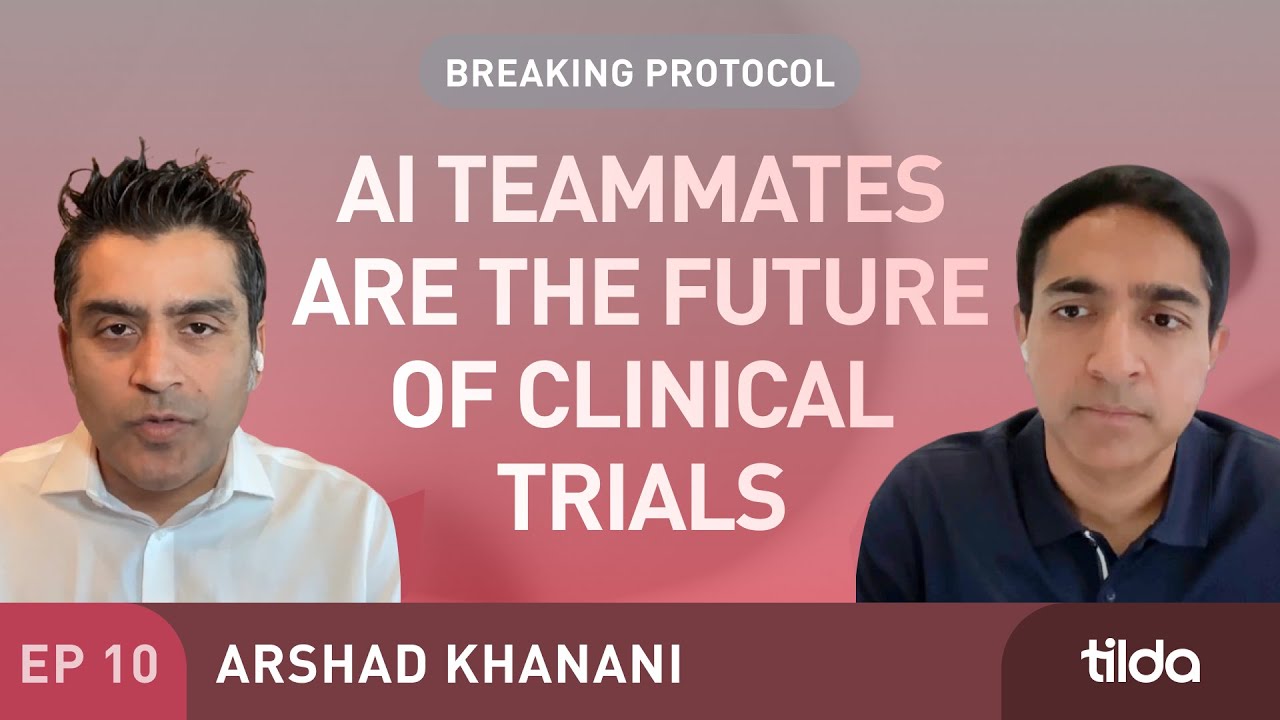
In this bonus episode, Dr. Arshad Khanani, one of the most prolific clinical trial investigators in ophthalmology, sits down with Tilda CEO Ram Yalamanchili to explore how AI is reshaping the clinical research landscape. Drawing from his 15+ years of experience and 150+ trials, Dr. Khanani breaks down the real-world challenges faced by sites, CROs, and sponsors. Together, they discuss how AI teammates can reduce site burden, accelerate trial activation, and improve data quality.
Key topics covered:
1) The staffing crisis in clinical research and how AI can help
2) Why site activation delays happen—and how AI agents streamline CRO coordination
3) Using AI to support regulatory, billing, and query resolution
4) How AI-enabled sites can increase trial capacity without hiring
5) The opportunity to scale new research sites faster with AI support
Whether you're a sponsor, CRO, or site leader, this conversation delivers an honest, practitioner-led view on the operational pain points in clinical trials, and why now is the time to invest in intelligent automation.
Transcript
30 min
Ram Yalamanchili (00:02.851)
Today we have Dr. Kanani, who's a renowned physician, investigator, many things in the, overall a wonderful person in the retina space who I've got to know. And I'm really excited to talk to you, Dr. Kanani, so welcome.
Arshad M. Khanani MD, MA (00:19.298)
Thanks, Ram. Looking forward to our discussion. It's been great working with you and learning what you are trying to do to make our space better. So looking forward to it.
Ram Yalamanchili (00:29.507)
Absolutely. So, you know, before we start, I'd love to sort of get a quick overview of your background and maybe even tell us like how did you get into the space, right? How did you become a Rednaz specialist?
Arshad M. Khanani MD, MA (00:43.872)
Yeah, thanks, Ram. So I've been in practice here in Reno, Nevada for 15 years at CRI Associates. I'm also a clinical professor at the University of Nevada, Reno School of Medicine. I'm a medical and surgical retina specialist. And that journey started long time ago. When I was a little kid, my grandmother had complications from a cataract surgery. At that time,
Fico emulsification was coming and she ended up with a complication. We led her to go to the ophthalmologist office for many visits. And as a little kid, I used to go and I thought ophthalmologists were pretty cool with all their gadgets and headlights and machines and tools. So that's how I got interested in ophthalmology. And then after medical school, obviously I went into ophthalmology residency.
I had interest in research even when I was a student in St. Louis at WashU. I did some lab research and I realized that I like humans better than being in a lab or working with mice and frogs. So I ended up doing some clinical trials as a resident in Texas and also as a fellow. And my big interest now obviously has been
Ram Yalamanchili (01:47.522)
So, thank
Arshad M. Khanani MD, MA (02:04.3)
coming up with novel treatments for our patients and being very active in clinical trials. So we created the clinical trial unit at CRI Associates after I started. And it's been a great journey since then. I've served as a PI for 150 clinical trials and worked on many of the new treatments that are available for patients. But as a physician, my always goal is to, how can we make the space better?
in terms of obviously bringing new treatments for patients, but also the trial space has a lot of challenges and I work closely with industries and industry, let me retake that. I work closely with industry sponsors, CROs, and as well as companies like you, how we can collaborate to make things better. So it's been a good journey and I think we can always do things better and that's why I was impressed with what you can offer to our space.
Ram Yalamanchili (02:59.19)
Great, thank you. And I also, you know, I would say my introduction to you and sort of talking to you for the very first time, and this was like maybe, you know, earlier this year or late last year.
One of the things which really like was interesting is you also brought this understanding of how technology could meaningfully change the operational overhead or whatever the challenges were sort of like about talking, talk about, right? So one of the things which I was curious about is you've done a very skilled sort of an operation, not only at your clinic, but through your involvement with the community, with CTS, the conference you run.
Tell us a little bit more about sort of your experience with technology. How do you view it in terms of adoption or even like, know, just understanding it, right? being a medical practitioner, obviously like coming into new tech and working with them.
Arshad M. Khanani MD, MA (03:59.008)
Yeah, Ron, that's a very good question. think over the last 15 years, you know, we have been involved in all the cutting edge stuff. And I think what I've seen is that either you embrace technology or you don't. And if you embrace technology, you're going to actually become better. You're going to be more efficient. You'll deliver better quality. You'll have less cost. And, know, I still at the end of the day, you know, running the business.
from all standpoints. So I need to have understanding of how a technology can help me, sponsors, CROs, and that will deliver better outcomes, maybe more efficient trials. So we have adopted technology at every level as we can, whether it is documentation, whether it is using technology to select patients for clinical trial. And I think it's a boom that we are seeing with artificial intelligence now.
And you mentioned CTS, I think one of the top rated session at CTS was the session actually you spoke in is artificial intelligence, because everybody is curious about how artificial intelligence is gonna be a part of our day to day world in medical and clinical trial space. And I think what's gonna happen is it's gonna be involved at every level. Now, artificial intelligence and technology can get confusing because
not all technologies are the same and not all artificial intelligence opportunities are the same. So I think there's still a lack of understanding from the community about what can a certain artificial intelligence company or agent or whatever device or imaging technology can do. So I think for me, I see it very clearly. I see that technology is gonna help.
at every level and specifically talking about clinical trials is going to help sponsors. It's going to help CROs and it's going to help us because we're always looking for staff and adding more staff. it's always a challenge how to run a busy clinical trial unit. We are one of the busiest one in the country because we continue to deliver for every single sponsor. But it takes a lot of work from the back end to do that. And I think technology will really help us become more efficient.
Ram Yalamanchili (06:18.016)
So just seguing into that, right? I think now we're coming into this idea of, especially in the AI news cycle, this whole concept of an agent. I would say it's a relatively new thing which most people are hearing about. We've been working on agents for years now, but I'm just saying like in terms of where the overall understanding is, I think it's starting to really come in. It just so happened that OpenAI just recently launched something called an OpenAI agent, which is like,
bringing it to a billion people, right? That they have a billion people using their product. And so I think it's going to get very much mainstream and sort of saying, well, AI for the last two years has been largely conversational. So I'm having a chat with it. I'm asking questions, I'm uploading a document and reformatting it, this sort of thing. And then we went from conversation to sort of generative. So you can generate videos, images now. They're very high fidelity. And I think now...
What will be very interesting and magical from a experience perspective, which I we're all excited about it till there is how do you then say my AI can do something for me and I can hand it off and then it goes does something and then comes back and it'll it'll be exactly like working with a very competent teammate who you can trust and you know, it's all kind of deterministic in some ways, right? But I think the gap, of course, is that you can go do that in a general purpose like chat GPT type of an agent.
our industry, the clinical trial industry is a very specialized industry. There's a lot of vertical knowledge and information which we have to understand. And there's also certain methodology in all the processes which we have. So it has to be customized. It has to be built in a certain way where adoption is easy for you and me and everybody else in our industry, right? So I am definitely like in that view that evolution is happening right now very quickly. And because the ROI is...
sort of very high to sort of get into this model. I think I sort of see this as like a make or break situation. think big careers will be made and at the same time, big opportunities will be brought in. So it's all gonna be an interesting next few months to years. So from there, I'm curious, given what you know about AI and everything you've studied and researched so far, what do you think are sort some of the impactful things which you're excited about from?
Ram Yalamanchili (08:44.336)
Any of the actors we just spoke about, CRO sponsor sites.
Arshad M. Khanani MD, MA (08:47.822)
Well, I think we have to break it down at different levels, right? So let's talk about CROs. When I look at CROs, obviously they're always short staff. They always have people coming and leaving, and there is sometimes lack of internal communication. As a site, we'll get an email, I'm taking over, and then they can't find the documents that they send by the last person because it wasn't secured or placed somewhere. So we are getting this...
kind of questions years down the road from a trial, can you send us a site activation letter that we sent you? So I think from a CRO level, it's gonna be very organized and streamlined if they can use AI agents to do a lot of site startup from their standpoint, collecting documents from a site, being more efficient, reaching out and reminding the site what they want, having the list of trial, you know, like,
individuals from each side, because we have so many employees and they are working on different trials. They'll email the wrong person and they'll copy me or they'll email a person that has already left. So there's a lot of challenges I see. think the biggest challenge though is retaining staff. So let's say they use an AI agent is going to be consistent, you know, presence, right? And, and you'll be able to streamline that activation or the paperwork from the CRO perspective.
to get the sites up and running much quicker. A lot of time things go quiet. And as a site, I don't know who to reach out to. And I ended up actually reaching out to sponsor most of the time, because sometimes I have an email from one person and that person is long gone and I don't get notified. So what I see is that technology is going to really change how CROs operate. And obviously CROs are already adapting to technology, but I think specifically using AI agent is going to be really, really helpful.
for CROs to actually make the trials more efficient in terms of site activation, communication and organization. Now, what about sponsors, right? So sponsors wanna get trials executed faster and they wanna get the data because there's only so much runway, especially if you're a biotech. And as you know, I work with a lot of biotechs in many different roles as an advisor. So I see that using technology at different levels. So if...
Arshad M. Khanani MD, MA (11:13.77)
CROs can activate sites quicker. That's going to help the sponsors. And then from a site perspective, the sponsors like to find the patients and enroll into trials. So there's a lot of different platforms that are out there to data mine locally or cloud-based from a patient level, connecting them to EHR to get the right patients for the trials. Obviously that's being refined and we have multiple different players.
in that space. But I also see AI as a screening tool, right? In terms of like, if you have, if you found the right patient.
there's a way for an AI tool to run the full eligibility. That's been a challenge and I think is evolving. So AI can let's find an image that is going to qualify, but didn't look at the whole medical history, didn't look at all the con meds, didn't look at all the other ocular history, timing of the disease. So I think what I'm seeing there Ram is that actually technology is evolving.
Ram Yalamanchili (11:53.583)
Mm.
Arshad M. Khanani MD, MA (12:15.058)
So sponsors are to really benefit as you talk about return on investment, that if we can activate sites much faster, we can enroll the sites much quicker. And then also from the sponsor side, there's data monitoring from sponsor side, looking at images, looking at communication from sponsors, sending newsletters out, keeping the sites motivated. So I think AI agents can actually take that role there, right? That they can be your
key contact and can answer questions because my concern is, you know, I'm in Pacific time zone and it's 6 p.m. and I have a question for a sponsor and most of the sponsor, you know, are sitting on East Coast and that's too late, right? Or even it's a global study, you're sitting in China or India and you are trying to get a hold of person in the U.S. So I see that from a sponsor perspective, you have these
Ram Yalamanchili (12:53.788)
Mm-hmm.
Arshad M. Khanani MD, MA (13:11.946)
AI agents just responding to the basic questions the site have. what do I do if I have this? What do I do if I have this? And I'm sure you, you and the team can have modeling to kind of have those basic answers. And the most of those answers actually exists in the protocol. It's just that sometimes sites cannot read a 200 page protocol when they have an acute issue and we are all digging through stuff. I know I can find an answer. Maybe there was an amendment that, that changed it, but that letter didn't come out or we miss it. So.
Ram Yalamanchili (13:38.3)
you
Arshad M. Khanani MD, MA (13:41.646)
So those are the things I'm seeing. think from a sponsor perspective, it's going to be very, very streamlined from data management, right? Like whether you're a CRO or a sponsor queries, you know, generating queries, some of the most painful thing we have is having queries that make no sense, right? You know, yesterday we had a trial that sent us 300 queries in a day and they're like, well, resolve them. And half of them are unfortunately.
Not that great. So you have an AI agent that's actually looking at the data in a real time fashion and querying based on the protocol or querying, you know, things that make sense. so I think those are the things I see it. And lastly, Ram, from a site perspective, it will be a game changer, right? I'm always looking for good, people to help me as clinical.
Ram Yalamanchili (14:29.281)
you
Arshad M. Khanani MD, MA (14:34.414)
know, core research coordinators as well as coordinator assistants, as well as photographers and BCVA techs, right? So I see that much of the paperwork that delays activation is going to be done by AI agents. Most of the data entry, image uploads.
Ram Yalamanchili (14:37.179)
you
Ram Yalamanchili (14:50.3)
you
Arshad M. Khanani MD, MA (14:53.0)
are going to be done by AI agents. then accounting, right? Accounting is a really difficult part, but the reality of a clinical trial unit is that you can do a lot of work but not get paid for it because there's all these subtleties about what to invoice, what is a flat fee, you know, is amendment to budget is being accounted for in your payment.
somebody who has to follow with the CROs all the time to kind of say, okay, where is that payment? I didn't see it. Sometimes I've had trials, we didn't get paid for two years. And so I think from both end, from CRO end, as well as from a site end, if you have communication with AI agents to help with accounting and billing and all that is going to be very helpful. So I personally see that in the next three to five years, AI will be a big part of clinical trials.
Ram Yalamanchili (15:22.725)
Thanks.
Arshad M. Khanani MD, MA (15:45.536)
at all levels. And I think AI agents are going to really make a huge difference for us to be more efficient. And as you said, you know, have better ROI because we are going to save a lot of
timelines and as well as lot of costs that's associated with adding people to our practice. Now, of course, I'm not saying humans are going away. It's still going to be led by us, but I think we can do a lot of tasks that we are struggling to do because of time constraints or, you know, staff shortages that will be done by AI.
Ram Yalamanchili (16:18.487)
I have a follow-up question on the site side. I'm sure in the past 15 years of you working in this field, you've seen the evolution of these research practices or practices adopting research as one of the programs in their services, right? So how do you see that now? Like, you know, do you see new sites being created? Is that enough? Is the pace of that, you know, matching what the demand is?
Is there opportunity there for new sites to say, I can be, I can, know, confidently do this work and maybe there were some barriers prior than now there's other ways to do it. I'm just curious how you see this evolving from an ecosystem.
Arshad M. Khanani MD, MA (17:01.9)
No, I think that's a great question, Ram. And the thing is that the answer is no. There's not enough new sites to account for all the trials that we have. I can only have so many trials for geographic atrophy or for wet AMD or DME, because we don't have unlimited supply of patients. And many of the trials have similar inclusion, exclusion criteria. So what we do as a site is that we kind of time it.
we've cake one or two and focus and enroll big and then we take the next one and enroll big. But, you know, as you can see that the same sites are coming in top five or 10 in every trial and, and, that's just not sustainable. And so there are some new sites coming in, but the biggest barrier they have is that they don't have the regulatory expertise. They don't have the SOPs. They don't know how to do the budgets. They don't know how to communicate.
with the sponsor CRO. They don't know how to do the EDC, right? So I think what I see is that now with the help of AI agents, we'll be able to help them get into research much easier, right? So I helped many of my colleagues who are successful now establish research, but they struggled for months. Even though I was there to guide them, I was not sitting in their office telling them how to do this regulatory paperwork or how to
Ram Yalamanchili (18:18.554)
you
Arshad M. Khanani MD, MA (18:25.112)
put data in EDC and how to answer queries and how to report an adverse event or SAE or protocol deviation. So those are the things that people struggle with. at the end of the day, it has to be done right because this is human subject research. Obviously audit can happen anytime by regulatory agencies. You want to take care of the patients. You want to follow the protocol.
Over the last 10 to 15 years, what I've seen is the biggest barrier has been not having the expertise or the staff. People struggle getting staff. So I see that now you get one key study coordinator and then use AI agents to help that coordinator be much more efficient, right? Because when I first started, I only had one and they were doing regulatory and they were doing uploads and they're doing data entry and it was just too overwhelming. So what I see that some sites start
Ram Yalamanchili (19:09.113)
Okay.
Arshad M. Khanani MD, MA (19:20.354)
There was a site that started recently and put a lot of patients in one trial and I'm like, why did you stop? They're like, we don't have the manpower to do it anymore. We already have too many patients in this trial. only have two coordinators and we cannot grow until we hire somebody else. So, well, now they can use AI agents to help them streamline many of the things that they're spending time on. And then the coordinators can actually focus on bigger things to grow.
Ram Yalamanchili (19:29.241)
Thank
Arshad M. Khanani MD, MA (19:47.404)
the clinical trial network and do more studies.
Ram Yalamanchili (19:51.033)
See, one of the things I'm very curious on how you see this is we all sort of agree where the world is going. mean, know, AI is going to come. There's no question about that. And AI will be something we will have to, you know, some way adopt over the next course of months to years. However, I think there's still, I'm sure, adoption challenges or apprehensions on sort of bringing AI. Why would I do that? Why don't I just hire, you know,
additional staff and things like that, right? One point I'm curious about, especially on the regulatory side, which because you brought that up is, you know, I see it as two alternatives, right? You can have an agent manage your regulatory and compliance from a site's perspective. And, you know, your staff is still oversighting it and making sure everything's okay. Or you can say, well, I already have a coordinator who does great work on this. You know, I know they're busy. We'll just continue to the regular, the traditional path.
What in your way, in your view, you know, like we'll shift that mindset from saying, I'm going to just go the traditional route versus say, I'm going to try something so new. And, know, sort of like, it's just a completely new concept to sort of bring this augmented AI teammate, as we call it, to that person, to that coordinator, right? So from your, from a PI perspective or investigator perspective, how, what would be the risk reward and sort of like what your analysis will be in terms of the option there?
Arshad M. Khanani MD, MA (21:18.67)
Well, I think, you know, as human beings, you're always nervous when there is a change, right? I mean, you may be too young, but there was a change from, you know, rotary phones to cell phones and to flip phones to iPhones. And there's always like this fear that, oh, what can go wrong when I do something new? Right. And, you know, you saw during COVID, like,
Everything went virtual. We didn't do that by choice, but it had to happen. And now we realize that that's actually the best thing that happened. You I don't have most of my meetings in person flying a day or two, spending time, money and resources to meet somebody. Now I'm doing it virtually. Right. So, so there is like, you know, initially there is a fear that, can we be productive? Can we be more efficient? Can we actually follow the rules? So.
So yeah, I mean, from a site level, there's going to be anxiety when you are getting AI agents in, but I think the proof is in the pudding, right? When people hear the word AI, they get confused, but let's say your platform, you have already implemented in many different practices and many of my friends are using your platform and they're very, very happy. And these are people who are trialists for a decade or longer. And, and, and now diving into either new practice or growing their practice. So as a company, if you show me.
Ram Yalamanchili (22:16.344)
you
Ram Yalamanchili (22:40.76)
Thanks.
Arshad M. Khanani MD, MA (22:45.356)
that you're doing this, I'm okay with it, but I still may be nervous. But if a friend of mine that is on the side side and I've known them to be a great clinical trialist and they tell me that, hey, this is actually very helpful, my nervousness and anxiety goes down. So I think at the end of the day, either you adapt, as I said, and embrace it or you don't. And...
We embrace it, but we have to be careful, right? Like we can't just give everything to AI agent to do regulatory without watching them, as you said. So for me, from a site perspective, I see as, okay, we have a regulatory coordinator, but they're stretched thin. Too much to do, not enough time. Can we get an AI agent to help?
that regulatory coordinator to kind of manage things more efficiently, right? As you said, it's more about efficiency, time saving, and we know that the quality will be great because they're all trained on good model. I hope it is, right, Ram? Otherwise, it's gonna be difficult.
Ram Yalamanchili (23:46.148)
Yeah. No, yeah, I mean, that's the hard work, right? That's what companies like ourselves pride ourselves on. And that's what I think we should bring to the market. Anybody who's in the AI space, right? We should have good evaluations, good benchmarking, good data to say, hey, my models are trained and they're behaving this way on a consistent basis. Another segue here is because we're talking about
regulatory, I also look at it from a lens of risk. So, you you want to do everything right, because there's an audit and audits, you know, the outcomes can be great, but there is that small chance that maybe there's a, you know, a risk of some sort, which can come out of that as well. So I'm just curious, like, you know, you can have the greatest regulatory coordinator with you, but is there an issue here where if that person leaves,
then the risk essentially like goes up in some ways. Like is that a concern in some ways where the longevity of that person sort of determines the amount of risk you're taking in your program in some ways from a PIS perspective?
Arshad M. Khanani MD, MA (24:52.974)
Oh, 100%. I think you bring up a really good point. Every day I have a fear that what's going to happen if this person left the research department because they have so much responsibility. And we have backup for everybody, but the backups are not deep into either the trial or the regulatory paperwork. You know, the main person that's going to know everything about the trial will be the lead coordinator. There's clearly a risk because, as I said, if you have so many different trials, you need to
on a daily basis, manage the regulatory folders and, and, and delegation logs and amendment training and, making sure you're up to date. So whether you have a regulatory coordinator or not, think AI agents can really help you. So if you have some expert that can, that's helping you, AI can make them more efficient, right? And that's also gives us cost saving and time saving. Right. So.
Instead of me hiring a backup that is going to cost a lot, agent can really track with their regulatory monitor or coordinator to help them be efficient. the risk is, yes, if something happens to them, how do we go around dealing with it? Is everything up to date? That's the biggest challenge because when there is too much going on, it's hard to keep a track. So that's why you need to have multiple people.
Ram Yalamanchili (26:17.754)
Okay.
Arshad M. Khanani MD, MA (26:18.51)
So I agree with you, there's always a daily risk. And you know, we wanna make sure that all of my colleagues and I, our goal is to do everything to the point in terms of regulatory paperwork. And I think the struggles come in when you have unexpected events or departures in the practice. I've seen that many times where many of my colleagues who are really high enrollers in trials suddenly stop enrolling. And then when I asked them, hey, what happened?
As I mentioned one about the new site that they didn't have additional resources here, the coordinator left or two coordinators left. And now they're behind on data entry. They're behind on their regulatory. They're behind on their billing. And then they're not enrolling new patients, which is also affecting their revenue stream. It's impacting the sponsor because sponsors now are getting less recruitment from that site.
Ram Yalamanchili (26:54.473)
Mm-hmm.
Arshad M. Khanani MD, MA (27:11.97)
So I think it's a full circle, right? Like we saw at CTS, we all work together to bring new products, you, CROs, sponsors and sites. And I think what you can do and the AI agent technology can do is actually work with all the stakeholders to make the process more efficient, know, save time, have better quality, less risk and cost savings as you mentioned.
Ram Yalamanchili (27:29.622)
you
questions.
Arshad M. Khanani MD, MA (27:38.114)
So I think I'm really excited as a site and being involved in different things is that we have to do this better. And it is going to start from CROs and sites. And then obviously the sponsors are going to benefit and also implement it.
Ram Yalamanchili (27:54.461)
Yeah, no, this has been a wonderful conversation. Thank you. One thing I want to say in a closer is I know we spoke quite a bit about the site pain points. It's eerie how similar these pain points translate even to the sponsors and CRS we work with. They have the same exact types of challenges, slightly different viewpoint. But this is an industry which has largely
I think it's easy from a site perspective to say you're not organized on the other side, they're very similar challenges which the other side faces as well. Which is like a kind of a learning experience for me over the past many months of working with our partners and customers lately. But I appreciate everything you've said, Dr. Gunani. Thank you so much.
Arshad M. Khanani MD, MA (28:41.602)
No, thanks, Ram. It was a pleasure to discuss the pain points and I'm hoping together with technology, AI and AI agents will be able to make this process more efficient. And all these pain points are here, Ram, because it's busy. There's a lot of innovation, which is good for patients, which is good for our fields. We're all working hard to bring new treatments for our patients and that's why we're having this conversation. So.
Ram Yalamanchili (28:57.812)
Mm-hmm.
Arshad M. Khanani MD, MA (29:08.812)
So hopefully we all continue to work together to make it better so we can preserve vision for our patients with retinal diseases. Thank you.
Ram Yalamanchili (29:16.788)
Great. Thank you so much.
Ram Yalamanchili (00:02.851)
Today we have Dr. Kanani, who's a renowned physician, investigator, many things in the, overall a wonderful person in the retina space who I've got to know. And I'm really excited to talk to you, Dr. Kanani, so welcome.
Arshad M. Khanani MD, MA (00:19.298)
Thanks, Ram. Looking forward to our discussion. It's been great working with you and learning what you are trying to do to make our space better. So looking forward to it.
Ram Yalamanchili (00:29.507)
Absolutely. So, you know, before we start, I'd love to sort of get a quick overview of your background and maybe even tell us like how did you get into the space, right? How did you become a Rednaz specialist?
Arshad M. Khanani MD, MA (00:43.872)
Yeah, thanks, Ram. So I've been in practice here in Reno, Nevada for 15 years at CRI Associates. I'm also a clinical professor at the University of Nevada, Reno School of Medicine. I'm a medical and surgical retina specialist. And that journey started long time ago. When I was a little kid, my grandmother had complications from a cataract surgery. At that time,
Fico emulsification was coming and she ended up with a complication. We led her to go to the ophthalmologist office for many visits. And as a little kid, I used to go and I thought ophthalmologists were pretty cool with all their gadgets and headlights and machines and tools. So that's how I got interested in ophthalmology. And then after medical school, obviously I went into ophthalmology residency.
I had interest in research even when I was a student in St. Louis at WashU. I did some lab research and I realized that I like humans better than being in a lab or working with mice and frogs. So I ended up doing some clinical trials as a resident in Texas and also as a fellow. And my big interest now obviously has been
Ram Yalamanchili (01:47.522)
So, thank
Arshad M. Khanani MD, MA (02:04.3)
coming up with novel treatments for our patients and being very active in clinical trials. So we created the clinical trial unit at CRI Associates after I started. And it's been a great journey since then. I've served as a PI for 150 clinical trials and worked on many of the new treatments that are available for patients. But as a physician, my always goal is to, how can we make the space better?
in terms of obviously bringing new treatments for patients, but also the trial space has a lot of challenges and I work closely with industries and industry, let me retake that. I work closely with industry sponsors, CROs, and as well as companies like you, how we can collaborate to make things better. So it's been a good journey and I think we can always do things better and that's why I was impressed with what you can offer to our space.
Ram Yalamanchili (02:59.19)
Great, thank you. And I also, you know, I would say my introduction to you and sort of talking to you for the very first time, and this was like maybe, you know, earlier this year or late last year.
One of the things which really like was interesting is you also brought this understanding of how technology could meaningfully change the operational overhead or whatever the challenges were sort of like about talking, talk about, right? So one of the things which I was curious about is you've done a very skilled sort of an operation, not only at your clinic, but through your involvement with the community, with CTS, the conference you run.
Tell us a little bit more about sort of your experience with technology. How do you view it in terms of adoption or even like, know, just understanding it, right? being a medical practitioner, obviously like coming into new tech and working with them.
Arshad M. Khanani MD, MA (03:59.008)
Yeah, Ron, that's a very good question. think over the last 15 years, you know, we have been involved in all the cutting edge stuff. And I think what I've seen is that either you embrace technology or you don't. And if you embrace technology, you're going to actually become better. You're going to be more efficient. You'll deliver better quality. You'll have less cost. And, know, I still at the end of the day, you know, running the business.
from all standpoints. So I need to have understanding of how a technology can help me, sponsors, CROs, and that will deliver better outcomes, maybe more efficient trials. So we have adopted technology at every level as we can, whether it is documentation, whether it is using technology to select patients for clinical trial. And I think it's a boom that we are seeing with artificial intelligence now.
And you mentioned CTS, I think one of the top rated session at CTS was the session actually you spoke in is artificial intelligence, because everybody is curious about how artificial intelligence is gonna be a part of our day to day world in medical and clinical trial space. And I think what's gonna happen is it's gonna be involved at every level. Now, artificial intelligence and technology can get confusing because
not all technologies are the same and not all artificial intelligence opportunities are the same. So I think there's still a lack of understanding from the community about what can a certain artificial intelligence company or agent or whatever device or imaging technology can do. So I think for me, I see it very clearly. I see that technology is gonna help.
at every level and specifically talking about clinical trials is going to help sponsors. It's going to help CROs and it's going to help us because we're always looking for staff and adding more staff. it's always a challenge how to run a busy clinical trial unit. We are one of the busiest one in the country because we continue to deliver for every single sponsor. But it takes a lot of work from the back end to do that. And I think technology will really help us become more efficient.
Ram Yalamanchili (06:18.016)
So just seguing into that, right? I think now we're coming into this idea of, especially in the AI news cycle, this whole concept of an agent. I would say it's a relatively new thing which most people are hearing about. We've been working on agents for years now, but I'm just saying like in terms of where the overall understanding is, I think it's starting to really come in. It just so happened that OpenAI just recently launched something called an OpenAI agent, which is like,
bringing it to a billion people, right? That they have a billion people using their product. And so I think it's going to get very much mainstream and sort of saying, well, AI for the last two years has been largely conversational. So I'm having a chat with it. I'm asking questions, I'm uploading a document and reformatting it, this sort of thing. And then we went from conversation to sort of generative. So you can generate videos, images now. They're very high fidelity. And I think now...
What will be very interesting and magical from a experience perspective, which I we're all excited about it till there is how do you then say my AI can do something for me and I can hand it off and then it goes does something and then comes back and it'll it'll be exactly like working with a very competent teammate who you can trust and you know, it's all kind of deterministic in some ways, right? But I think the gap, of course, is that you can go do that in a general purpose like chat GPT type of an agent.
our industry, the clinical trial industry is a very specialized industry. There's a lot of vertical knowledge and information which we have to understand. And there's also certain methodology in all the processes which we have. So it has to be customized. It has to be built in a certain way where adoption is easy for you and me and everybody else in our industry, right? So I am definitely like in that view that evolution is happening right now very quickly. And because the ROI is...
sort of very high to sort of get into this model. I think I sort of see this as like a make or break situation. think big careers will be made and at the same time, big opportunities will be brought in. So it's all gonna be an interesting next few months to years. So from there, I'm curious, given what you know about AI and everything you've studied and researched so far, what do you think are sort some of the impactful things which you're excited about from?
Ram Yalamanchili (08:44.336)
Any of the actors we just spoke about, CRO sponsor sites.
Arshad M. Khanani MD, MA (08:47.822)
Well, I think we have to break it down at different levels, right? So let's talk about CROs. When I look at CROs, obviously they're always short staff. They always have people coming and leaving, and there is sometimes lack of internal communication. As a site, we'll get an email, I'm taking over, and then they can't find the documents that they send by the last person because it wasn't secured or placed somewhere. So we are getting this...
kind of questions years down the road from a trial, can you send us a site activation letter that we sent you? So I think from a CRO level, it's gonna be very organized and streamlined if they can use AI agents to do a lot of site startup from their standpoint, collecting documents from a site, being more efficient, reaching out and reminding the site what they want, having the list of trial, you know, like,
individuals from each side, because we have so many employees and they are working on different trials. They'll email the wrong person and they'll copy me or they'll email a person that has already left. So there's a lot of challenges I see. think the biggest challenge though is retaining staff. So let's say they use an AI agent is going to be consistent, you know, presence, right? And, and you'll be able to streamline that activation or the paperwork from the CRO perspective.
to get the sites up and running much quicker. A lot of time things go quiet. And as a site, I don't know who to reach out to. And I ended up actually reaching out to sponsor most of the time, because sometimes I have an email from one person and that person is long gone and I don't get notified. So what I see is that technology is going to really change how CROs operate. And obviously CROs are already adapting to technology, but I think specifically using AI agent is going to be really, really helpful.
for CROs to actually make the trials more efficient in terms of site activation, communication and organization. Now, what about sponsors, right? So sponsors wanna get trials executed faster and they wanna get the data because there's only so much runway, especially if you're a biotech. And as you know, I work with a lot of biotechs in many different roles as an advisor. So I see that using technology at different levels. So if...
Arshad M. Khanani MD, MA (11:13.77)
CROs can activate sites quicker. That's going to help the sponsors. And then from a site perspective, the sponsors like to find the patients and enroll into trials. So there's a lot of different platforms that are out there to data mine locally or cloud-based from a patient level, connecting them to EHR to get the right patients for the trials. Obviously that's being refined and we have multiple different players.
in that space. But I also see AI as a screening tool, right? In terms of like, if you have, if you found the right patient.
there's a way for an AI tool to run the full eligibility. That's been a challenge and I think is evolving. So AI can let's find an image that is going to qualify, but didn't look at the whole medical history, didn't look at all the con meds, didn't look at all the other ocular history, timing of the disease. So I think what I'm seeing there Ram is that actually technology is evolving.
Ram Yalamanchili (11:53.583)
Mm.
Arshad M. Khanani MD, MA (12:15.058)
So sponsors are to really benefit as you talk about return on investment, that if we can activate sites much faster, we can enroll the sites much quicker. And then also from the sponsor side, there's data monitoring from sponsor side, looking at images, looking at communication from sponsors, sending newsletters out, keeping the sites motivated. So I think AI agents can actually take that role there, right? That they can be your
key contact and can answer questions because my concern is, you know, I'm in Pacific time zone and it's 6 p.m. and I have a question for a sponsor and most of the sponsor, you know, are sitting on East Coast and that's too late, right? Or even it's a global study, you're sitting in China or India and you are trying to get a hold of person in the U.S. So I see that from a sponsor perspective, you have these
Ram Yalamanchili (12:53.788)
Mm-hmm.
Arshad M. Khanani MD, MA (13:11.946)
AI agents just responding to the basic questions the site have. what do I do if I have this? What do I do if I have this? And I'm sure you, you and the team can have modeling to kind of have those basic answers. And the most of those answers actually exists in the protocol. It's just that sometimes sites cannot read a 200 page protocol when they have an acute issue and we are all digging through stuff. I know I can find an answer. Maybe there was an amendment that, that changed it, but that letter didn't come out or we miss it. So.
Ram Yalamanchili (13:38.3)
you
Arshad M. Khanani MD, MA (13:41.646)
So those are the things I'm seeing. think from a sponsor perspective, it's going to be very, very streamlined from data management, right? Like whether you're a CRO or a sponsor queries, you know, generating queries, some of the most painful thing we have is having queries that make no sense, right? You know, yesterday we had a trial that sent us 300 queries in a day and they're like, well, resolve them. And half of them are unfortunately.
Not that great. So you have an AI agent that's actually looking at the data in a real time fashion and querying based on the protocol or querying, you know, things that make sense. so I think those are the things I see it. And lastly, Ram, from a site perspective, it will be a game changer, right? I'm always looking for good, people to help me as clinical.
Ram Yalamanchili (14:29.281)
you
Arshad M. Khanani MD, MA (14:34.414)
know, core research coordinators as well as coordinator assistants, as well as photographers and BCVA techs, right? So I see that much of the paperwork that delays activation is going to be done by AI agents. Most of the data entry, image uploads.
Ram Yalamanchili (14:37.179)
you
Ram Yalamanchili (14:50.3)
you
Arshad M. Khanani MD, MA (14:53.0)
are going to be done by AI agents. then accounting, right? Accounting is a really difficult part, but the reality of a clinical trial unit is that you can do a lot of work but not get paid for it because there's all these subtleties about what to invoice, what is a flat fee, you know, is amendment to budget is being accounted for in your payment.
somebody who has to follow with the CROs all the time to kind of say, okay, where is that payment? I didn't see it. Sometimes I've had trials, we didn't get paid for two years. And so I think from both end, from CRO end, as well as from a site end, if you have communication with AI agents to help with accounting and billing and all that is going to be very helpful. So I personally see that in the next three to five years, AI will be a big part of clinical trials.
Ram Yalamanchili (15:22.725)
Thanks.
Arshad M. Khanani MD, MA (15:45.536)
at all levels. And I think AI agents are going to really make a huge difference for us to be more efficient. And as you said, you know, have better ROI because we are going to save a lot of
timelines and as well as lot of costs that's associated with adding people to our practice. Now, of course, I'm not saying humans are going away. It's still going to be led by us, but I think we can do a lot of tasks that we are struggling to do because of time constraints or, you know, staff shortages that will be done by AI.
Ram Yalamanchili (16:18.487)
I have a follow-up question on the site side. I'm sure in the past 15 years of you working in this field, you've seen the evolution of these research practices or practices adopting research as one of the programs in their services, right? So how do you see that now? Like, you know, do you see new sites being created? Is that enough? Is the pace of that, you know, matching what the demand is?
Is there opportunity there for new sites to say, I can be, I can, know, confidently do this work and maybe there were some barriers prior than now there's other ways to do it. I'm just curious how you see this evolving from an ecosystem.
Arshad M. Khanani MD, MA (17:01.9)
No, I think that's a great question, Ram. And the thing is that the answer is no. There's not enough new sites to account for all the trials that we have. I can only have so many trials for geographic atrophy or for wet AMD or DME, because we don't have unlimited supply of patients. And many of the trials have similar inclusion, exclusion criteria. So what we do as a site is that we kind of time it.
we've cake one or two and focus and enroll big and then we take the next one and enroll big. But, you know, as you can see that the same sites are coming in top five or 10 in every trial and, and, that's just not sustainable. And so there are some new sites coming in, but the biggest barrier they have is that they don't have the regulatory expertise. They don't have the SOPs. They don't know how to do the budgets. They don't know how to communicate.
with the sponsor CRO. They don't know how to do the EDC, right? So I think what I see is that now with the help of AI agents, we'll be able to help them get into research much easier, right? So I helped many of my colleagues who are successful now establish research, but they struggled for months. Even though I was there to guide them, I was not sitting in their office telling them how to do this regulatory paperwork or how to
Ram Yalamanchili (18:18.554)
you
Arshad M. Khanani MD, MA (18:25.112)
put data in EDC and how to answer queries and how to report an adverse event or SAE or protocol deviation. So those are the things that people struggle with. at the end of the day, it has to be done right because this is human subject research. Obviously audit can happen anytime by regulatory agencies. You want to take care of the patients. You want to follow the protocol.
Over the last 10 to 15 years, what I've seen is the biggest barrier has been not having the expertise or the staff. People struggle getting staff. So I see that now you get one key study coordinator and then use AI agents to help that coordinator be much more efficient, right? Because when I first started, I only had one and they were doing regulatory and they were doing uploads and they're doing data entry and it was just too overwhelming. So what I see that some sites start
Ram Yalamanchili (19:09.113)
Okay.
Arshad M. Khanani MD, MA (19:20.354)
There was a site that started recently and put a lot of patients in one trial and I'm like, why did you stop? They're like, we don't have the manpower to do it anymore. We already have too many patients in this trial. only have two coordinators and we cannot grow until we hire somebody else. So, well, now they can use AI agents to help them streamline many of the things that they're spending time on. And then the coordinators can actually focus on bigger things to grow.
Ram Yalamanchili (19:29.241)
Thank
Arshad M. Khanani MD, MA (19:47.404)
the clinical trial network and do more studies.
Ram Yalamanchili (19:51.033)
See, one of the things I'm very curious on how you see this is we all sort of agree where the world is going. mean, know, AI is going to come. There's no question about that. And AI will be something we will have to, you know, some way adopt over the next course of months to years. However, I think there's still, I'm sure, adoption challenges or apprehensions on sort of bringing AI. Why would I do that? Why don't I just hire, you know,
additional staff and things like that, right? One point I'm curious about, especially on the regulatory side, which because you brought that up is, you know, I see it as two alternatives, right? You can have an agent manage your regulatory and compliance from a site's perspective. And, you know, your staff is still oversighting it and making sure everything's okay. Or you can say, well, I already have a coordinator who does great work on this. You know, I know they're busy. We'll just continue to the regular, the traditional path.
What in your way, in your view, you know, like we'll shift that mindset from saying, I'm going to just go the traditional route versus say, I'm going to try something so new. And, know, sort of like, it's just a completely new concept to sort of bring this augmented AI teammate, as we call it, to that person, to that coordinator, right? So from your, from a PI perspective or investigator perspective, how, what would be the risk reward and sort of like what your analysis will be in terms of the option there?
Arshad M. Khanani MD, MA (21:18.67)
Well, I think, you know, as human beings, you're always nervous when there is a change, right? I mean, you may be too young, but there was a change from, you know, rotary phones to cell phones and to flip phones to iPhones. And there's always like this fear that, oh, what can go wrong when I do something new? Right. And, you know, you saw during COVID, like,
Everything went virtual. We didn't do that by choice, but it had to happen. And now we realize that that's actually the best thing that happened. You I don't have most of my meetings in person flying a day or two, spending time, money and resources to meet somebody. Now I'm doing it virtually. Right. So, so there is like, you know, initially there is a fear that, can we be productive? Can we be more efficient? Can we actually follow the rules? So.
So yeah, I mean, from a site level, there's going to be anxiety when you are getting AI agents in, but I think the proof is in the pudding, right? When people hear the word AI, they get confused, but let's say your platform, you have already implemented in many different practices and many of my friends are using your platform and they're very, very happy. And these are people who are trialists for a decade or longer. And, and, and now diving into either new practice or growing their practice. So as a company, if you show me.
Ram Yalamanchili (22:16.344)
you
Ram Yalamanchili (22:40.76)
Thanks.
Arshad M. Khanani MD, MA (22:45.356)
that you're doing this, I'm okay with it, but I still may be nervous. But if a friend of mine that is on the side side and I've known them to be a great clinical trialist and they tell me that, hey, this is actually very helpful, my nervousness and anxiety goes down. So I think at the end of the day, either you adapt, as I said, and embrace it or you don't. And...
We embrace it, but we have to be careful, right? Like we can't just give everything to AI agent to do regulatory without watching them, as you said. So for me, from a site perspective, I see as, okay, we have a regulatory coordinator, but they're stretched thin. Too much to do, not enough time. Can we get an AI agent to help?
that regulatory coordinator to kind of manage things more efficiently, right? As you said, it's more about efficiency, time saving, and we know that the quality will be great because they're all trained on good model. I hope it is, right, Ram? Otherwise, it's gonna be difficult.
Ram Yalamanchili (23:46.148)
Yeah. No, yeah, I mean, that's the hard work, right? That's what companies like ourselves pride ourselves on. And that's what I think we should bring to the market. Anybody who's in the AI space, right? We should have good evaluations, good benchmarking, good data to say, hey, my models are trained and they're behaving this way on a consistent basis. Another segue here is because we're talking about
regulatory, I also look at it from a lens of risk. So, you you want to do everything right, because there's an audit and audits, you know, the outcomes can be great, but there is that small chance that maybe there's a, you know, a risk of some sort, which can come out of that as well. So I'm just curious, like, you know, you can have the greatest regulatory coordinator with you, but is there an issue here where if that person leaves,
then the risk essentially like goes up in some ways. Like is that a concern in some ways where the longevity of that person sort of determines the amount of risk you're taking in your program in some ways from a PIS perspective?
Arshad M. Khanani MD, MA (24:52.974)
Oh, 100%. I think you bring up a really good point. Every day I have a fear that what's going to happen if this person left the research department because they have so much responsibility. And we have backup for everybody, but the backups are not deep into either the trial or the regulatory paperwork. You know, the main person that's going to know everything about the trial will be the lead coordinator. There's clearly a risk because, as I said, if you have so many different trials, you need to
on a daily basis, manage the regulatory folders and, and, and delegation logs and amendment training and, making sure you're up to date. So whether you have a regulatory coordinator or not, think AI agents can really help you. So if you have some expert that can, that's helping you, AI can make them more efficient, right? And that's also gives us cost saving and time saving. Right. So.
Instead of me hiring a backup that is going to cost a lot, agent can really track with their regulatory monitor or coordinator to help them be efficient. the risk is, yes, if something happens to them, how do we go around dealing with it? Is everything up to date? That's the biggest challenge because when there is too much going on, it's hard to keep a track. So that's why you need to have multiple people.
Ram Yalamanchili (26:17.754)
Okay.
Arshad M. Khanani MD, MA (26:18.51)
So I agree with you, there's always a daily risk. And you know, we wanna make sure that all of my colleagues and I, our goal is to do everything to the point in terms of regulatory paperwork. And I think the struggles come in when you have unexpected events or departures in the practice. I've seen that many times where many of my colleagues who are really high enrollers in trials suddenly stop enrolling. And then when I asked them, hey, what happened?
As I mentioned one about the new site that they didn't have additional resources here, the coordinator left or two coordinators left. And now they're behind on data entry. They're behind on their regulatory. They're behind on their billing. And then they're not enrolling new patients, which is also affecting their revenue stream. It's impacting the sponsor because sponsors now are getting less recruitment from that site.
Ram Yalamanchili (26:54.473)
Mm-hmm.
Arshad M. Khanani MD, MA (27:11.97)
So I think it's a full circle, right? Like we saw at CTS, we all work together to bring new products, you, CROs, sponsors and sites. And I think what you can do and the AI agent technology can do is actually work with all the stakeholders to make the process more efficient, know, save time, have better quality, less risk and cost savings as you mentioned.
Ram Yalamanchili (27:29.622)
you
questions.
Arshad M. Khanani MD, MA (27:38.114)
So I think I'm really excited as a site and being involved in different things is that we have to do this better. And it is going to start from CROs and sites. And then obviously the sponsors are going to benefit and also implement it.
Ram Yalamanchili (27:54.461)
Yeah, no, this has been a wonderful conversation. Thank you. One thing I want to say in a closer is I know we spoke quite a bit about the site pain points. It's eerie how similar these pain points translate even to the sponsors and CRS we work with. They have the same exact types of challenges, slightly different viewpoint. But this is an industry which has largely
I think it's easy from a site perspective to say you're not organized on the other side, they're very similar challenges which the other side faces as well. Which is like a kind of a learning experience for me over the past many months of working with our partners and customers lately. But I appreciate everything you've said, Dr. Gunani. Thank you so much.
Arshad M. Khanani MD, MA (28:41.602)
No, thanks, Ram. It was a pleasure to discuss the pain points and I'm hoping together with technology, AI and AI agents will be able to make this process more efficient. And all these pain points are here, Ram, because it's busy. There's a lot of innovation, which is good for patients, which is good for our fields. We're all working hard to bring new treatments for our patients and that's why we're having this conversation. So.
Ram Yalamanchili (28:57.812)
Mm-hmm.
Arshad M. Khanani MD, MA (29:08.812)
So hopefully we all continue to work together to make it better so we can preserve vision for our patients with retinal diseases. Thank you.
Ram Yalamanchili (29:16.788)
Great. Thank you so much.